Walk into any furniture store or scroll through any home decor platform and you will find full length mirrors in two dominant frame materials: wood and metal. Both are presented as premium options. Both have genuine advocates. But in the context of an Indian bedroom — with its specific humidity conditions, aesthetic preferences and material culture — the comparison is not as balanced as the marketing suggests. Here is an honest assessment of both.
The Metal Mirror: What It Does Well
Metal-framed mirrors have genuine strengths. They are structurally rigid, which means a large full length mirror in a metal frame holds its shape without flex. They are available in a wide range of finishes — matte black, brushed gold, chrome, antique brass — which makes them versatile across different aesthetic directions. And they are generally resistant to the kind of surface degradation that affects wood and MDF frames in high-humidity environments.
For a bathroom mirror or a mirror in a very high-humidity space, a metal frame has a genuine advantage. Metal does not absorb moisture the way wood does, which means it does not swell or warp in extreme humidity conditions.
What the Metal Mirror Does Poorly
Metal conducts temperature. In a bedroom with air conditioning, a metal-framed mirror feels cold to the touch. In a bedroom without air conditioning in an Indian summer, it feels warm. This temperature conductivity is not a safety issue but it is a comfort one — a mirror you brush against while dressing should not feel like a cold radiator.
Metal also reads as industrial in a bedroom designed around natural materials. A matte black metal frame in a room with a solid wooden bed, linen textiles and a warm neutral palette creates a material tension that is difficult to resolve. The metal frame belongs to a different material family from the other objects in the room, and the room feels assembled from separate decisions rather than designed as a whole.
Metal frames are also more likely to show fingerprints, scratches and surface wear in ways that are difficult to repair. A scratch on a metal frame is a scratch. A scratch on a solid pinewood frame can be lightly sanded and re-oiled, returning the surface to its original condition.
The Wooden Mirror: What It Does Well
A wooden frame mirror in solid pinewood belongs to the same material family as solid wood furniture, natural textiles and warm neutral palettes. In a bedroom built around natural materials, it creates material continuity rather than material tension. The room feels considered rather than assembled.
Solid pinewood is warm to the touch regardless of room temperature. It does not conduct heat or cold the way metal does, which means it feels neutral and comfortable in any climate condition. The matte oil finish on a solid pinewood frame is breathable, which means the wood manages seasonal humidity changes without stress. And the finish is repairable — a scratch or dent can be addressed with light sanding and re-oiling rather than requiring professional refinishing or replacement.
Solid pinewood also ages in the right direction. A metal frame that develops surface wear looks degraded. A solid pinewood frame that develops a patina over years of use looks more characterful. The ageing process is an asset rather than a liability.
The Indian Humidity Factor
In Indian monsoon conditions, the comparison shifts further toward solid wood. Metal frames are resistant to moisture absorption but are susceptible to corrosion, particularly in coastal cities where salt air accelerates oxidation. A matte black metal frame in Mumbai or Chennai will show surface corrosion within a few years if the finish is not perfectly maintained. A brushed gold or chrome finish is similarly vulnerable.
A solid pinewood frame with a breathable matte oil finish handles Indian humidity by absorbing and releasing moisture as a single piece. It does not corrode. It does not develop surface oxidation. It responds to humidity by moving slightly and returning to its original dimensions when the humidity normalises. Over multiple monsoon cycles, a solid pinewood frame remains structurally and aesthetically sound in ways that a metal frame in a coastal Indian city may not.
The Akari Pinewood Mirror in Context
The Akari Pinewood Mirror is a full length floor mirror in solid pinewood with a matte finish. In the context of the wooden vs metal comparison, it represents the wooden option at its most considered: solid rather than veneered, matte rather than glossy, proportioned for a bedroom rather than for a showroom.
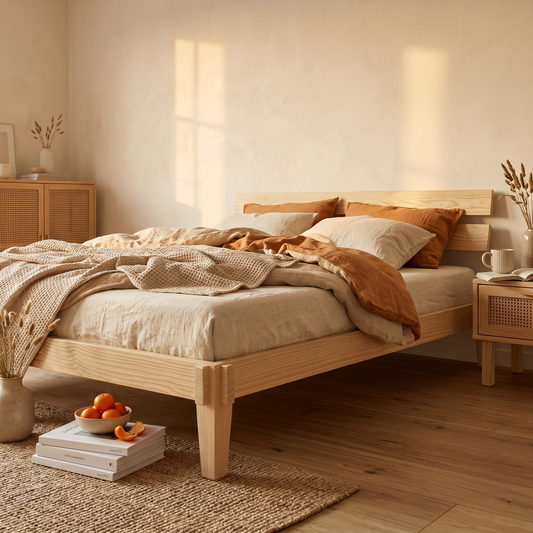
In a bedroom with the Poka Bed, the Akari Mirror creates the material continuity that makes a bedroom feel designed. The same solid pinewood, the same matte finish, the same design philosophy. A metal mirror in the same room would create a material tension that no amount of styling can fully resolve.
The Honest Verdict
For a bathroom or a very high-humidity utility space, a metal frame has a genuine case. For a bedroom in an Indian home, particularly one built around natural materials and a warm neutral palette, solid wood is the more intelligent choice in almost every dimension: tactile comfort, material compatibility, ageing quality and long-term performance in Indian humidity conditions. The metal mirror is not wrong. It is just less right for this specific context.