There are furniture pairings that are greater than the sum of their parts. The sofa and the coffee table. The dining table and the bench. The bed and the bedside table. But one of the most powerful and least discussed pairings in home design is the wooden console and the mirror. Together, they transform a bare wall into a considered space — one that has surface, reflection, depth and presence simultaneously. Here is why this pairing works so well and how to get it right.
What Each Piece Does Alone
A wooden console table alone gives a wall a surface. It is functional — somewhere to put things — but it does not give the wall depth or visual presence beyond its own footprint. A mirror alone gives a wall reflection and the appearance of depth, but without a surface beneath it, it floats on the wall without grounding and the space below it is unresolved.
Together, the console and the mirror solve each other's limitations. The console grounds the mirror and gives it a base that makes the combination read as a unit rather than two separate objects. The mirror gives the console a vertical extension that draws the eye upward and makes the wall feel taller. The surface of the console holds the objects that belong near a mirror — a tray, a plant, a lamp — without cluttering the floor. The reflection of the mirror amplifies the light from the lamp on the console. Each piece makes the other more effective.
The Proportional Logic
The proportions of the console-and-mirror pairing matter significantly. A mirror that is too small relative to the console looks like an afterthought. A mirror that is too large overwhelms the console and makes the combination feel top-heavy. The ideal proportion is a mirror that is roughly the same width as the console or slightly narrower, and tall enough to extend from just above the console surface to near the ceiling.
A full length floor mirror leaned against the wall behind a console achieves this proportion naturally. The mirror's height extends from the floor to near the ceiling, which gives the wall a strong vertical presence. The console sits in front of the mirror's base, which grounds the combination and creates the surface that the pairing needs. The leaning angle of the mirror means it reflects the room at a slight upward angle, which is more spatially expansive than a flat-mounted mirror reflecting the room directly.
Where the Pairing Works Best
The console-and-mirror pairing works in almost any transitional space in the home. In an entryway, it creates the first impression of the home and the last moment of self-possession before leaving. In a hallway, it gives the passage a destination rather than just a direction. In a bedroom, it creates a dressing station that has the quality of a considered space. In a living room, it gives a bare wall a focal point that is both functional and spatial.
The entryway is the most powerful position for this pairing because it is the space where the transition between the public and private self happens. A wooden console with a full length mirror above it in the entryway marks this transition with material honesty and visual calm. The home begins well.
The Nagomi Console and the Akari Mirror
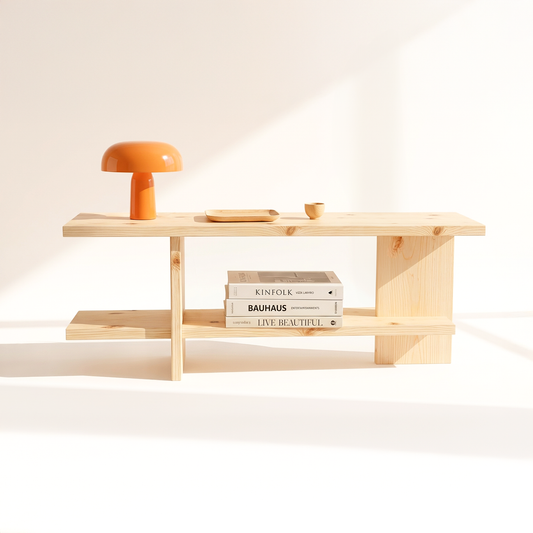
The Nagomi Pinewood Console by A Good Life and the Akari Pinewood Mirror are designed to be used together. Both are made from solid pinewood with a matte finish. Both belong to the same design philosophy: honest materials, clean lines, nothing unnecessary. The console is narrow enough to fit in an entryway and deep enough to hold the objects of daily life. The mirror is a full length floor mirror that leans against the wall behind the console, giving the combination the vertical presence that makes the pairing work.
In an entryway, the Nagomi Console holds keys, a small tray and a plant. The Akari Mirror leans behind it, reflecting the entryway and the natural light from the door. The combination reads as a considered space rather than a transitional one. The home begins with material honesty and visual calm.
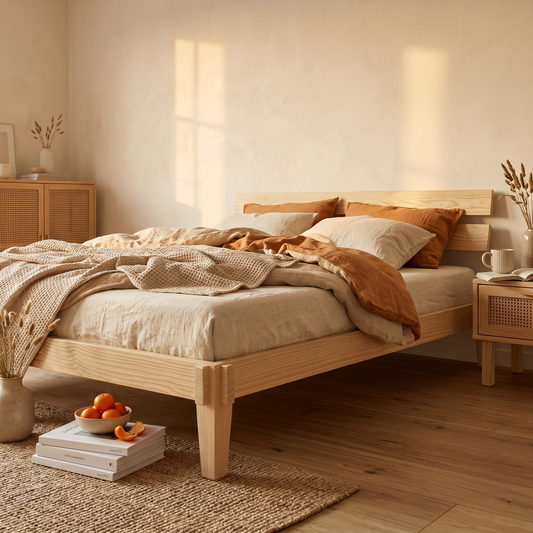
In a bedroom, the same pairing creates a dressing station. The console holds the objects of the morning routine. The mirror provides the full-length reflection in morning light. The Poka Bed in the same solid pinewood anchors the room. Three pieces, one material, one home.
The Objects on the Console Surface
The surface of a wooden console is a curated space. It should hold only the objects that belong there — the ones that are used daily or that contribute to the visual quality of the space. A small tray to corral keys and small objects. A plant in a simple pot. A warm lamp. A single object of personal significance. Nothing more.
The discipline of the console surface is the discipline of the home in miniature. Every object earns its place or it does not stay. The console that is kept to this standard is the console that makes the space feel considered rather than accumulated. It is the difference between a surface that works and one that merely exists.
The Wall That Became a Room
A bare wall is a missed opportunity. A wooden console and a full length mirror transform it into a space that has surface, reflection, depth, light and presence. The wall becomes a room. The corridor becomes an entryway. The transitional space becomes a destination. This is what the console-and-mirror pairing does, and it does it with two pieces of solid pinewood and the intention to use them well.