For two decades, the Indian home storage market was dominated by flat-pack furniture. Engineered wood, laminate finishes, bolt-together assembly and a price point that made replacement feel easier than repair. The category worked because it was affordable and because the alternative — solid wood cabinetry — was either custom-made at significant cost or imported at even greater cost. That is changing. Solid wooden cabinets are returning to Indian homes, and the reasons are more practical than aesthetic.
What Flat-Pack Storage Does to a Home Over Time
The flat-pack storage cabinet looks acceptable when new. The laminate surface is smooth, the edges are clean and the doors hang straight. Three monsoons later, the picture is different. The laminate has lifted at the edges where moisture has penetrated. The MDF substrate has swollen at the base where it has been in contact with a slightly damp floor. The bolt-together joints have loosened as the material around the bolt holes has compressed. The doors no longer hang straight.
This is not a quality control failure. It is the predictable outcome of a material that was not designed for Indian humidity conditions. MDF and particleboard absorb moisture unevenly, which causes swelling, warping and delamination over multiple monsoon cycles. In a kitchen, where humidity is consistently higher than in other rooms, this process is accelerated.
What Solid Wood Does Instead
A solid wooden cabinet handles Indian humidity through a fundamentally different mechanism. Solid wood absorbs and releases moisture as a single continuous piece, which means it moves uniformly rather than swelling unevenly. The joints, if they are well-made, accommodate this movement without loosening. The finish, if it is breathable rather than sealed, allows the wood to manage moisture changes without internal stress.
A solid wooden cabinet that has been through ten Indian monsoons looks different from a new one — the wood has deepened in colour, the finish has developed a patina — but it is structurally sound and aesthetically honest. A flat-pack cabinet that has been through five Indian monsoons looks like it should have been replaced three years ago.
The Fluted Glass Cabinet: Solid Wood With Visual Intelligence
The return of solid wooden cabinets to Indian homes has coincided with the rise of fluted glass as a cabinet door material. The combination is not accidental. Fluted glass cabinet doors on a solid wood frame represent the most considered version of the wooden cabinet — one where the structural material is honest and the door material adds visual intelligence that solid wood alone cannot provide.
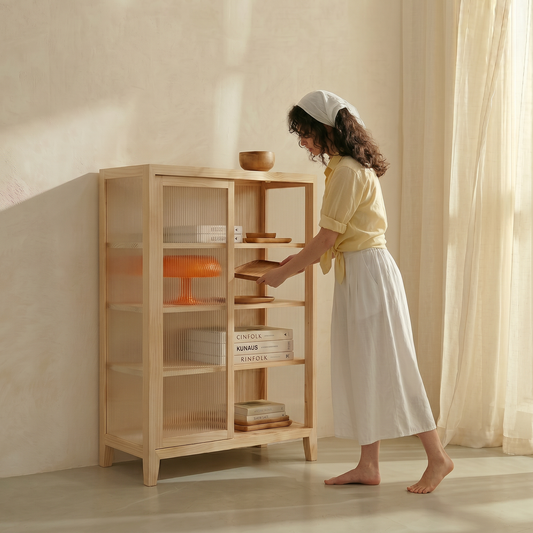
A fluted glass kitchen cabinet in solid pinewood holds everyday items behind doors that make the kitchen look considered from across the room. The textured glass suggests the contents without revealing them. The solid pinewood frame provides the structural integrity that engineered wood alternatives cannot match. The combination is greater than the sum of its parts.
The Kanso Fluted Cabinet: The Right Answer
The Kanso Fluted Cabinet by A Good Life is the solid wooden cabinet built for the Indian home. Solid pinewood frame, fluted glass cabinet doors, matte finish. It handles Indian humidity without swelling or warping. It ages by developing a patina rather than by degrading. And the fluted glass front panels provide the visual interest that makes it worth looking at as well as using.
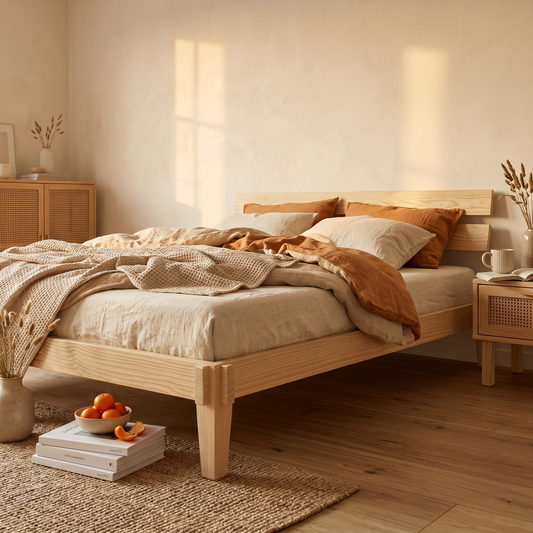
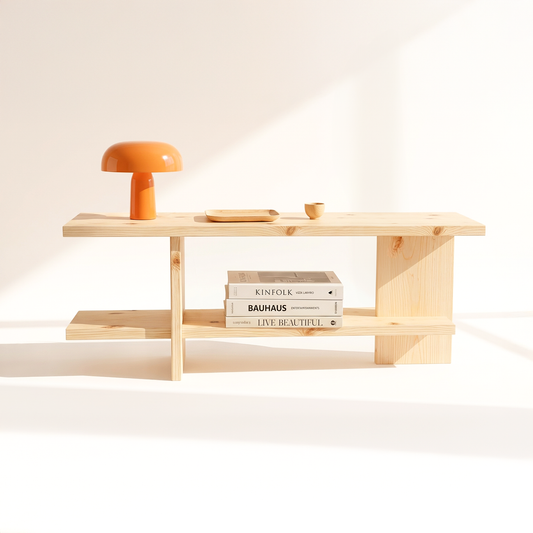
In a kitchen, the Kanso Cabinet replaces the flat-pack storage that has been failing quietly for years. In a living room, it provides storage with a visual presence that a solid-door cabinet cannot achieve. In a bedroom, it sits alongside the Poka Bed and the Akari Mirror as part of a material language that is consistent throughout the home. The Nagomi Pinewood Console in the entryway completes the picture.
The Cost Calculation That Changes Everything
A solid wooden cabinet costs more upfront than a flat-pack alternative. But a flat-pack cabinet replaced every five years costs more over fifteen years than a solid wooden cabinet that lasts the same period without replacement. The maths consistently favour solid wood over any meaningful time horizon. The wooden cabinet comeback is not nostalgia. It is arithmetic.