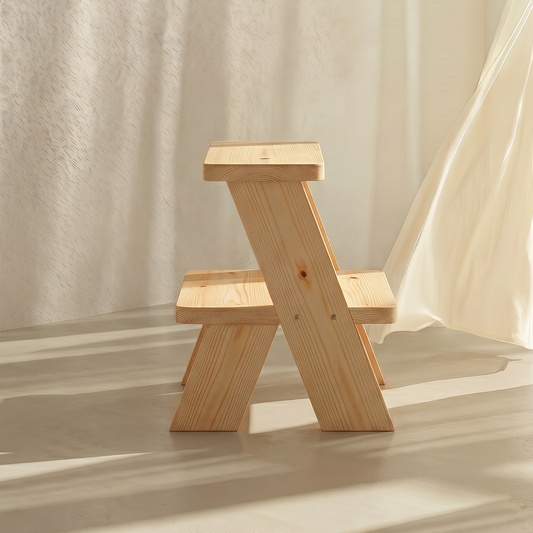

Anyone who has walked into a well-designed Japanese home, or even seen one in a photograph, will recognise the feeling immediately. It is not just tidy. It is genuinely calm. The kind of calm that slows your breathing and makes you want to stay. What is producing that feeling, and can you recreate it in an Indian bedroom? The answer is yes, and it starts with understanding what Japandi design is actually doing.
Japandi Is Not a Style. It Is a Philosophy.
The word Japandi is a portmanteau of Japanese and Scandinavian, but calling it a style undersells it. Both Japanese wabi-sabi and Scandinavian hygge are philosophies about how environments affect human wellbeing. Wabi-sabi finds beauty in imperfection and impermanence. Hygge finds comfort in warmth, simplicity and natural materials. Japandi design is what happens when these two philosophies meet in a room.
The result is not minimalism for its own sake. It is intentionality. Every object in a Japandi bedroom earns its place. Nothing is decorative without also being functional. Nothing is synthetic when natural is available. Nothing is loud when quiet will do.
The Japandi Bedroom: What It Actually Contains
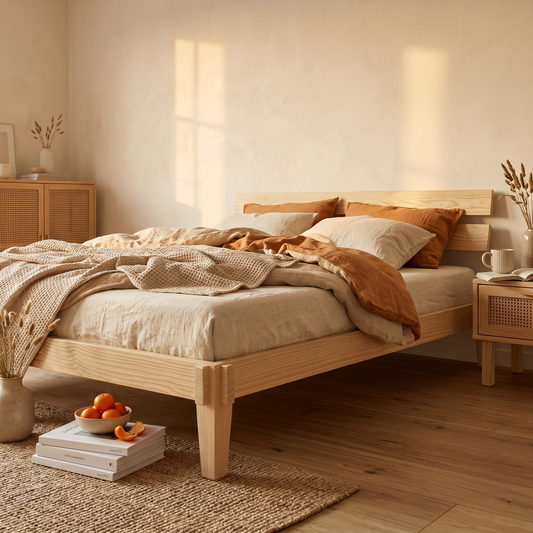
A Japandi bedroom typically has fewer pieces than a conventional bedroom, but each piece is chosen with more care. The bed is the centrepiece — a Japandi bed sits low to the ground, which lowers the visual centre of gravity of the room and creates a sense of groundedness. The frame is solid wood, unvarnished or matte-finished, with no visible hardware.
The palette is drawn from nature: warm whites, stone greys, sand tones and the natural colour of wood. Textiles are linen, cotton or wool — nothing synthetic. Lighting is warm and indirect. Surfaces are clear not because they are empty but because everything unnecessary has been removed.
This is not a difficult aesthetic to achieve. It is a disciplined one.
Why the Bed Frame Is the Most Important Decision
In a Japandi bedroom, the bed frame carries more visual weight than in a conventional room because there is less competing with it. A wrong choice is immediately visible. A right choice makes the entire room feel resolved.
The criteria for a Japandi bed are specific: solid wood, low profile, clean lines, no gloss, no visible bolts or brackets. Pinewood is particularly well-suited because its light colour and fine grain read as calm rather than heavy. It does not dominate the room the way darker hardwoods can.
The Poka Bed by A Good Life was designed with exactly these criteria. Solid pinewood, screwless joinery, a low silhouette and a matte finish that absorbs light rather than reflecting it. In a Japandi bedroom, it disappears in the best possible way — present without being loud, structural without being heavy.
The Role of the Mirror in a Japandi Bedroom
Mirrors in Japandi design are functional first. A full length mirror or standing mirror for bedroom use serves a clear purpose: it lets you see yourself fully before you leave the room. But in Japandi design, the frame matters as much as the glass.
A wooden frame mirror in solid pinewood reads as natural and warm. A chrome or plastic frame reads as industrial or cheap, neither of which belongs in a Japandi bedroom. A leaning floor mirror is preferred over a wall-mounted one because it is less permanent, easier to reposition and more consistent with the wabi-sabi principle of impermanence.
The Akari Pinewood Mirror is a full length floor mirror in solid pinewood designed to lean. The frame is matte-finished to match the natural material language of the room. In a Japandi bedroom, it functions as both a practical object and a quiet visual anchor — exactly what the philosophy asks for.
Japandi in an Indian Context
Indian homes present specific conditions that Japandi design handles well. High humidity, strong natural light and a cultural preference for warmth over austerity are all accommodated by the philosophy's emphasis on natural materials, warm palettes and functional simplicity.
Solid pinewood is particularly well-suited to Indian humidity when properly finished. It breathes rather than sealing moisture in, which prevents the warping and swelling that affects engineered wood in monsoon conditions. A solid wooden bed in a Japandi bedroom is not just aesthetically appropriate for India — it is materially appropriate.
The low profile of a Japandi bed also works well in Indian bedrooms, which often have lower ceiling heights than European homes. A low bed makes a room with a 9-foot ceiling feel taller. A high bed with a tall headboard does the opposite.
Where to Start
If you want to move your bedroom toward a Japandi aesthetic, the sequence matters. Start with the bed frame — it is the largest object and sets the tone for everything else. Then address the palette: remove anything synthetic in colour. Then the textiles. Then the lighting. The mirror comes last, placed where it adds depth without creating visual noise.
Each step is a subtraction as much as an addition. That is the point. A Japandi bedroom is not built by adding calm. It is built by removing everything that prevents it.