Everyone knows that mirrors make rooms feel larger. It is one of those design facts that gets repeated so often it has stopped being examined. But why does it actually happen? And more importantly, why do some mirrors make a room feel significantly larger while others do almost nothing? The answer is in the optics, and understanding it changes how you choose and place every mirror in your home.
What Your Brain Is Actually Doing
When you look into a mirror, your brain does not register it as a reflective surface. It registers it as a continuation of the space. The reflection is processed as depth — as a room beyond the glass — rather than as an image on a flat surface. This is not a trick or an illusion in the pejorative sense. It is how the visual cortex interprets reflected light, and it happens automatically, below the level of conscious thought.
The result is that a full length mirror on a wall does not read as a mirror. It reads as a doorway into another room. The brain adds the reflected space to the actual space and produces a perception of a room that is larger than its physical dimensions. This is why a well-placed full length floor mirror in a small bedroom can make the room feel genuinely larger rather than just appearing to.
Why Placement Determines Everything
If all mirrors made rooms feel larger, placement would not matter. But it does, enormously. A mirror that reflects a wall doubles the wall. A mirror that reflects a window doubles the light and the sky. A mirror that reflects the depth of the room doubles the depth. Only one of these outcomes makes the room feel larger.
The most effective placement for a standing mirror or full length mirror is perpendicular to or adjacent to a window. In this position, the mirror reflects natural light and the view beyond the window — sky, trees, open space — which the brain reads as exterior depth. The room appears to extend outward rather than inward, which is the most powerful spatial expansion a mirror can create.
A mirror placed directly opposite a window is the second most effective placement. It reflects the window itself, which doubles the apparent light source and creates a sense of two windows in a room that has one. In a bedroom with limited natural light, this placement can transform the quality of the space.
The Size Relationship
A small mirror in a large room does almost nothing for the perceived size of the space. The reflected area is too small relative to the room to register as meaningful depth. A full size mirror or full length mirror that occupies a significant portion of a wall creates a reflected space that the brain treats as a genuine extension of the room.
The minimum effective size for a mirror intended to expand a room is roughly the height of a person. A mirror shorter than 150 cm reflects a portion of the room rather than the whole of it, which limits the spatial expansion effect. A full length floor mirror between 150 and 180 cm tall reflects the room from floor to near-ceiling, which is the range that produces the most convincing sense of extended space.
The Frame and the Illusion
A heavy, ornate frame around a mirror draws attention to the mirror as an object rather than allowing the reflection to read as space. The brain is reminded that it is looking at a mirror rather than through a window, which partially breaks the spatial expansion effect.
A frame that is proportionally slim and visually quiet allows the reflection to dominate. A wooden frame mirror in solid pinewood with a matte finish does this well — the frame is present enough to give the mirror structure and warmth but not so dominant that it competes with the reflection. In a bedroom, this is the difference between a mirror that decorates and a mirror that genuinely expands.
The Akari Pinewood Mirror is a full length floor mirror in solid pinewood with a frame proportioned exactly for this purpose. The matte finish absorbs light rather than reflecting it, which keeps the frame visually recessive and allows the glass to do its spatial work. Leaned against a wall adjacent to a window, it produces the maximum spatial expansion effect available from a single mirror in a bedroom.
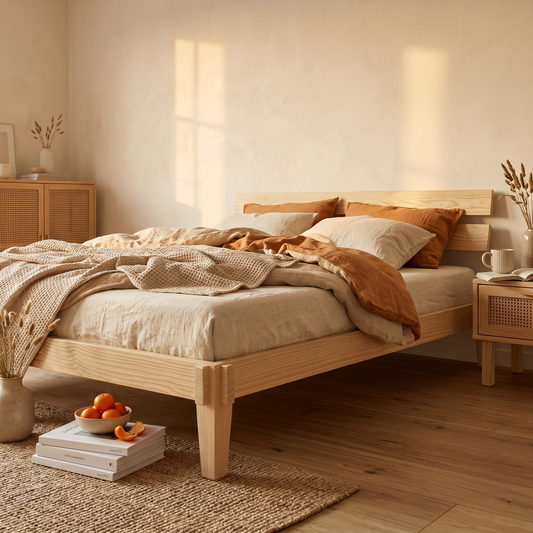
Pair it with the Poka Bed — a low solid pinewood bed frame with the same matte finish — and the two pieces create a bedroom where the material language is consistent and the spatial quality is genuinely better than the room's dimensions suggest.
Multiple Mirrors: When More Is Not Better
The instinct to add more mirrors to make a room feel even larger is understandable but usually counterproductive. Two mirrors facing each other create an infinite regression of reflections that reads as disorienting rather than spacious. Two mirrors on adjacent walls create competing depth cues that the brain cannot resolve into a coherent spatial impression.
One well-placed full length mirror does more for a room than three poorly placed smaller ones. The spatial expansion effect is maximised by a single large mirror in the optimal position, not by multiple mirrors in approximate positions.
The Room That Knows Its Own Size
Understanding the optics of mirrors does not require a design degree. It requires knowing what you want the mirror to reflect and placing it accordingly. Reflect light and you get brightness. Reflect depth and you get space. Reflect a wall and you get a wall. The mirror does exactly what you point it at. Point it at something worth reflecting.