Most full length mirrors are adequate. They reflect. They show you yourself. They do the basic job. But there is a category of mirror that does more than the basic job — one that improves the room it is in, ages better than the room around it and becomes more valued over time rather than less. Here is what separates a good full length mirror from a great one, and why the difference is worth understanding before you buy.
Glass Quality: The Variable That Determines the Reflection
The quality of the glass is the most important variable in a mirror and the one most frequently ignored in product listings. Standard mirror glass contains iron, which gives it a slight green tint. This tint is most visible at the edges of the mirror and in large reflections. In a small mirror, it is barely noticeable. In a full size mirror that you look into every morning, it produces a reflection that is subtly cooler and less accurate than the reality.
Low-iron glass, sometimes called ultra-clear or crystal-clear glass, has a significantly lower iron content. The reflection it produces is warmer, more accurate and more flattering. In a full length mirror for bedroom use, the difference between standard and low-iron glass is the difference between a reflection that makes you look slightly tired and one that shows you as you actually are.
A great full length mirror uses low-iron glass. A good one uses standard glass. This single variable accounts for more of the difference in reflection quality than frame material, size or any other specification.
Backing Quality: What Determines Longevity
The backing of a mirror is the layer behind the glass that creates the reflection. Standard mirror backing uses a silver or aluminium layer with a protective paint coat. Higher quality mirrors add a copper barrier layer between the silver and the paint, which significantly slows moisture penetration and extends the mirror's resistance to desilvering.
In Indian humidity conditions, backing quality is not a minor consideration. A mirror with standard backing in a coastal Indian city will begin showing desilvering — the black spots at the edges — within two to three years. A mirror with copper-barrier backing will resist desilvering significantly longer. The difference in longevity is meaningful and the difference in price is usually modest.
Frame Construction: Solid vs Hollow vs Composite
Mirror frames are made from three broad categories of material: solid wood, hollow or composite metal and MDF or particleboard. The differences in performance over time are significant.
A solid wood frame is structurally rigid, moisture-stable when properly finished and repairable when damaged. It holds its geometry over years of use and ages by developing a patina rather than by degrading. A hollow metal frame is structurally rigid but temperature-conductive and susceptible to surface corrosion in humid environments. An MDF frame is neither structurally rigid nor moisture-stable and is the most likely to fail at the corners in Indian humidity conditions.
A great full length mirror has a solid wood frame. A good one has a hollow metal frame. An adequate one has an MDF frame. The frame category is the second most important variable after glass quality.
Frame Proportions: The Detail That Determines Visual Quality
The proportions of the frame relative to the glass determine how the mirror reads in the room. A frame that is too wide relative to the glass makes the mirror read as a decorative object rather than a reflective surface. A frame that is too narrow provides insufficient structural rigidity and allows the glass to flex slightly, which distorts the reflection.
The ideal frame width for a full length floor mirror is between 4 and 8 cm. This range provides structural rigidity without visual dominance. The frame is present enough to give the mirror warmth and character but not so wide that it competes with the reflection.
The Akari Pinewood Mirror: Where These Variables Land
The Akari Pinewood Mirror is a full length floor mirror in solid pinewood designed to lean. The solid pinewood frame is proportioned within the ideal range for structural rigidity and visual quality. The matte finish is breathable, which means the frame manages Indian humidity without stress. The leaning format means no wall fixings, no installation risk and complete repositioning flexibility.
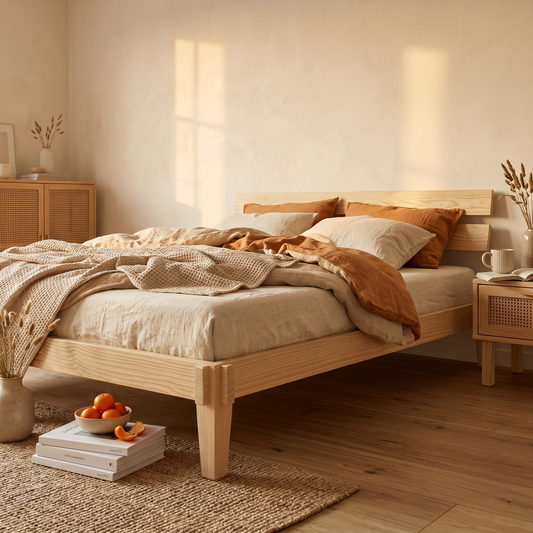
In a bedroom with the Poka Bed, the Akari Mirror brings the same material standard to the reflective element of the room that the Poka Bed brings to the structural element. Solid pinewood, matte finish, honest construction. A mirror that earns its place not through decoration but through quality.
The Test of Time
The difference between a good full length mirror and a great one is most visible not on the day of purchase but five years later. A good mirror looks fine when new and adequate after five years. A great mirror looks fine when new and better after five years — the glass is still clear, the frame has developed a patina that adds character and the reflection is as accurate as it was on day one.
This is the standard worth buying to. Not the mirror that looks good in the product photograph. The mirror that looks good in your bedroom in five years.