
Most people do not think about their bed frame until something goes wrong. A wobble. A creak that wakes a partner. A joint that has worked itself loose for the third time. By then, the bed has already failed — it just took a few years to show it.
Here is an honest look at what happens to low-cost beds over time and why a solid wooden bed behaves so differently.
Year One: Everything Seems Fine
A cheap bed frame looks perfectly acceptable out of the box. The finish is smooth, the joints are tight and the wobble, if there is one, is easy to dismiss. This is the honeymoon period. The MDF is still holding its shape. The bolts are still snug. The laminate has not yet started to lift at the edges.
What you cannot see yet is what is happening inside the material. Engineered wood is made from compressed fibres and adhesives. It responds to humidity and temperature by expanding and contracting unevenly. Every cycle of expansion and contraction loosens the joints slightly. Over twelve months, this is imperceptible. Over thirty-six, it is not.
Year Two: The Signals Start
The creak usually arrives in year two. It is not the mattress. It is the frame. The bolted joints have micro-movement now, and every time weight shifts on the bed, the frame flexes in ways it was not designed to. The laminate surface near stress points begins to show hairline separations. The legs, if hollow, develop a slight give.
This is also when the finish starts to look tired. Cheap lacquers yellow or dull under UV exposure. The bed that looked clean and minimal in year one now looks like it belongs in a rental property.
Year Three: The Decision Point
By year three, most low-cost beds are either being tolerated or replaced. The wobble is now structural. The joints cannot be re-tightened because the material around the bolt holes has compressed and lost its grip. The frame is not dangerous, but it is not stable either.
This is the moment most people realise they have paid twice — once for the cheap bed and once for the replacement.
What a Solid Wood Bed Frame Does Instead
A solid hardwood bed or solid wooden bedframe does not behave this way because the material itself is fundamentally different. Solid wood moves as a single piece. It expands and contracts with humidity, but it does so uniformly, which means joints stay tight rather than loosening through differential movement.
Screwless joinery, used in well-made solid wood beds, eliminates the bolt-hole compression problem entirely. The joints are held by the geometry of the wood itself — mortise-and-tenon or similar — which means they get tighter with use rather than looser.
The finish on a solid wooden bed also ages differently. A matte oil or wax finish on real wood develops a patina over time. It does not yellow or peel. It deepens. A ten-year-old solid wood bed frame, properly maintained, looks more characterful than it did when new. A ten-year-old MDF frame, if it has lasted that long, looks like it should have been replaced five years ago.
The Poka Bed: Built for the Long Argument
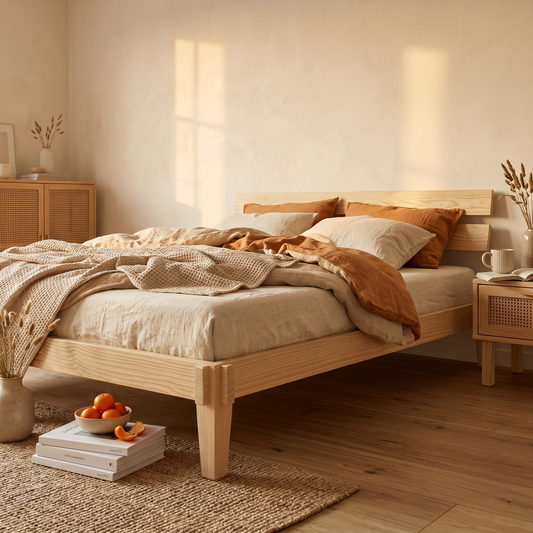
The Poka Bed by A Good Life is made from solid pinewood with screwless joinery throughout. There are no bolts to loosen, no laminate to lift and no hollow sections to compress. The low-profile Japandi bed silhouette means less leverage on the joints, which further extends the structural life of the frame.
It is not the cheapest bed you can buy online. It is the last one you should need to.
The Mirror That Follows the Same Logic
The same principle applies to every piece in a room. A wooden frame mirror made from solid pinewood will outlast a plastic-backed or MDF-framed mirror by years. The Akari Pinewood Mirror is a full length floor mirror built from the same solid pinewood as the Poka Bed. It stands without wall fixings, ages without degrading and looks better in year five than it did in year one.
When you are furnishing a bedroom, the question is not what is affordable now. It is what you will still be glad you bought in three years.
What to Look For When You Buy Wooden Bed Online
If you are ready to move away from engineered wood, here is what to verify before you buy a solid wood bed online:
- Confirm the species — pine, sheesham and teak all have different hardness and moisture response profiles.
- Ask about joinery — screwless or mortise-and-tenon is the benchmark. Bolt-together is a compromise.
- Check the slat material — solid wood slats flex correctly. MDF slats do not.
- Look at the finish — matte oil finishes are repairable. High-gloss lacquers are not.
A solid wooden bed is not a category. It is a standard. Make sure what you are buying actually meets it.