Psychologists who study living environments have a consistent finding: the bedroom is the most personally revealing room in a home. More than the living room, which is curated for guests, and more than the kitchen, which is organised around function, the bedroom reflects the inner life of the person who sleeps in it. What yours says about you may be more interesting than you expect.
The Bedroom as a Mirror of the Mind
Research by psychologist Sam Gosling, who has spent decades studying how living spaces reflect personality, found that bedrooms reveal traits that people often do not consciously express. An ordered bedroom with natural materials and a restrained palette tends to correlate with openness to experience and a preference for depth over novelty. A bedroom filled with objects, bright colours and layered textiles tends to correlate with extraversion and sensory seeking.
Neither is better. But both are telling. The bedroom is the room you design for yourself rather than for others, which means it reflects your actual preferences rather than your performed ones.
What a Cluttered Bedroom Is Actually Saying
Clutter in a bedroom is not laziness. Research consistently links bedroom clutter to elevated cortisol levels and disrupted sleep. The brain processes visual information even during the transition to sleep, and a cluttered environment keeps the threat-detection system mildly activated. The result is sleep that is lighter and less restorative than it should be.
The interesting thing is that the solution is not necessarily tidying. It is reducing. A bedroom with fewer objects that are each well-chosen produces less visual noise than a tidy bedroom with many objects. This is the principle behind the Japandi bedroom aesthetic — not minimalism for its own sake but intentional reduction that allows the nervous system to genuinely rest.
The Bed Frame as a Psychological Anchor
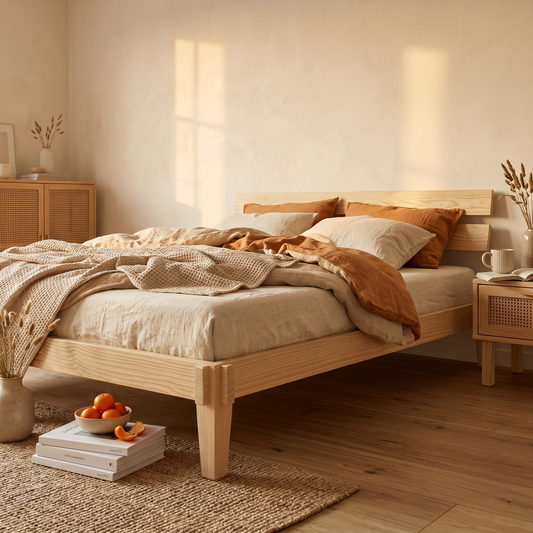
The bed is the largest object in the bedroom and the one the eye returns to most frequently. Its material, height and finish all contribute to the psychological register of the room. A high, ornate bed frame with a tall headboard creates a sense of formality and grandeur. A low, clean-lined solid wooden bed creates a sense of groundedness and calm.
The low profile of a Japandi bed is not arbitrary. It is a deliberate design choice rooted in the understanding that proximity to the ground is psychologically associated with safety and rest. Traditional Japanese sleeping arrangements — futons on tatami mats — are built on this principle. A solid wood bed frame that sits close to the ground brings the same quality to a Western bedroom format.
The Poka Bed by A Good Life is designed around this principle. The solid pinewood frame sits low, the lines are clean and the screwless joinery means there is no visible hardware to create visual tension. In a bedroom, it reads as settled — which is exactly what a bed should feel like.
Natural Materials and the Nervous System
The preference for natural materials in sleeping environments is not aesthetic preference. It is neurological. Biophilic design research consistently shows that exposure to natural materials — wood, stone, linen, cotton — activates the parasympathetic nervous system, which is the rest-and-digest state that is the opposite of the fight-or-flight response.
A bedroom furnished with solid hardwood beds, natural textiles and a wooden frame mirror is not just more beautiful than one furnished with synthetic materials. It is physiologically more conducive to rest. The brain recognises natural materials as safe in a way that it does not recognise plastic, metal or engineered wood.
This is why the material of your bed frame matters beyond aesthetics. A solid wooden bed is not just a design choice. It is an environmental one.
The Mirror and Self-Perception
A full length mirror in a bedroom does something that no other object does: it shows you yourself. The psychological implications of this are more significant than most people consider. A mirror that gives a true, warm reflection — clear glass, good light, a frame that does not distort the context — contributes to a positive self-perception in the morning. A mirror with a greenish tint, poor light or a frame that feels cheap creates a subtly negative one.
The placement matters too. A standing mirror for bedroom use positioned to catch morning light gives you the most accurate and flattering reflection. A mirror in a dark corner gives you the worst. The first thing you see of yourself in the morning sets a tone. It is worth getting right.
The Akari Pinewood Mirror is a full length floor mirror in solid pinewood with a frame that is warm without being heavy. As a leaning floor mirror, it can be positioned to catch the best light in your specific room. The solid pinewood frame reads as natural and grounded — the same material language as the bed, the same psychological register of calm.
The Bedroom You Deserve to Wake Up In
The bedroom is not a room you design once and forget. It is an environment you inhabit for roughly a third of your life. The materials in it, the objects in it and the way it is arranged all affect how you sleep, how you wake and how you feel about yourself in the first moments of each day.
A solid wooden bed, a considered palette, natural textiles and a well-placed full length mirror are not luxury decisions. They are investments in the quality of your daily experience. The psychology of bedroom design is not complicated. It is just rarely taken seriously enough.