Most people do not connect their bedroom mirror to their sleep quality. The mirror is a practical object for dressing and grooming, positioned wherever it fits and rarely reconsidered. But mirror placement in a bedroom has measurable effects on sleep, and the effects are almost always negative when the placement is wrong. Here is what is actually happening and what to do about it.
The Light Reflection Problem
The most direct way a mirror disrupts sleep is through light reflection. A full length mirror or standing mirror positioned to catch a light source — a window, a streetlight, a hallway light — reflects that light into the room and toward the bed. During the night, when the room should be as dark as possible, even low-level reflected light is enough to suppress melatonin and shift the brain toward lighter sleep stages.
This effect is most pronounced with mirrors positioned opposite windows. During summer months, when dawn arrives early, a mirror facing east will catch the first light of morning and direct it toward the bed, producing an involuntary early waking that feels like insomnia but is actually a light management problem. Moving the mirror or changing its angle is often enough to resolve it.
The Visual Stimulation Problem
The second way a mirror affects sleep is more subtle. A mirror directly opposite the bed reflects the sleeper back at themselves. During the transition to sleep, when the brain is processing the day and beginning to disengage from external stimuli, a reflection of movement — even the slight movement of breathing — in the peripheral visual field keeps the threat-detection system mildly activated.
This is not a dramatic effect. It does not prevent sleep. But it extends the time to fall asleep and keeps early sleep stages lighter than they would otherwise be. Over weeks and months, the cumulative effect on sleep quality is meaningful even if no single night feels dramatically disrupted.
The Feng Shui Explanation and the Scientific One
Feng shui has long advised against placing a mirror directly opposite the bed, attributing the problem to energy disruption. The scientific explanation is different but the practical conclusion is the same: a mirror facing the bed is not a good placement for sleep quality.
The scientific explanation involves the visual cortex's continued processing of environmental information during sleep transitions, the melatonin-suppressing effect of reflected light and the mild activation of the orienting response by movement in the visual field. These are not mystical effects. They are neurological ones. The feng shui practitioners arrived at the right answer through a different framework.
Where to Put the Mirror Instead
The placements that avoid sleep disruption while maximising the practical and spatial benefits of a full length floor mirror are straightforward.
Adjacent to the window, on the same wall, is the best position for most bedrooms. The mirror catches natural light during the day and reflects it into the room, which improves the quality of the space during waking hours. At night, when the window is covered, the mirror reflects nothing and causes no disruption. This placement gives you all the benefits of a well-placed mirror with none of the sleep costs.
In a corner, angled at roughly 45 degrees, is the second best option. The mirror reflects two walls simultaneously, creating a sense of depth that makes the room feel larger. At night, it reflects the corner rather than the bed, which avoids the visual stimulation problem. The angle also means it is unlikely to catch a direct light source.
Beside the wardrobe, on a wall perpendicular to the bed, is the most practical placement for dressing. It gives you a full reflection while getting dressed without being visible from the bed during sleep.
The Leaning Mirror Advantage
A leaning floor mirror has a practical advantage over a wall-mounted full length mirror when it comes to sleep optimisation: it can be repositioned. If you discover that your current mirror placement is affecting your sleep, moving a leaning mirror takes thirty seconds. Moving a wall-mounted mirror requires filling holes, repainting and remounting.
The Akari Pinewood Mirror is a full length floor mirror in solid pinewood designed to lean. The solid pinewood frame provides the weight and stability to hold the mirror safely in position without wall fixings, while the leaning format gives you the flexibility to find the placement that works best for your specific room and light conditions. The matte finish on the frame absorbs rather than reflects light, which further reduces the mirror's contribution to unwanted light in the room at night.
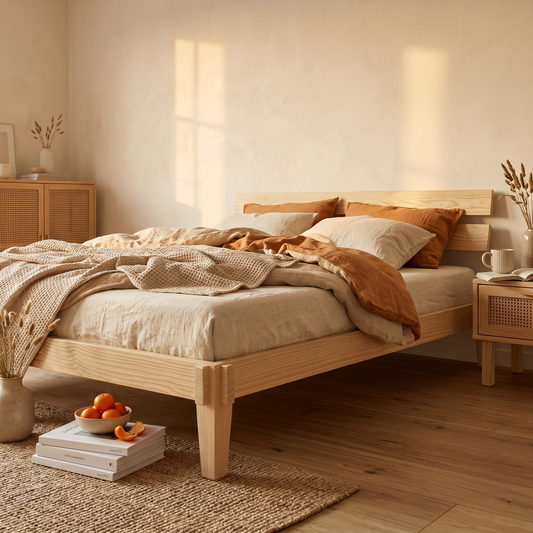
In a bedroom with the Poka Bed, the Akari Mirror positioned adjacent to the window creates a room where the natural material language is consistent and the sleep environment is genuinely considered. The low solid pinewood bed frame, the matte-finished mirror and the natural palette work together to produce a bedroom that supports rest rather than undermining it.
The Simple Fix
If you suspect your bedroom mirror is affecting your sleep, the test is simple. Move it to a position where it cannot reflect the bed or any light source visible from the bed. Sleep for a week. If your sleep improves, you have found the problem and the solution simultaneously.
Mirror placement is one of the easiest bedroom changes to make and one of the most frequently overlooked. The mirror that has been in the same position for three years because it fits there may be the reason you have been sleeping lightly for three years. It is worth checking.