The standing mirror is one of the oldest pieces of bedroom furniture still in common use. Its form has barely changed in five centuries. The glass is better, the frames are different and the manufacturing is more precise, but the object itself — a large reflective surface on a support, positioned to show a person their full reflection — is essentially the same object that appeared in European aristocratic bedrooms in the sixteenth century. The fact that it has survived this long without being replaced by something better is worth examining.
A Brief History of the Full Length Mirror
Before the seventeenth century, mirrors were small, expensive and made from polished metal rather than glass. A full reflection of the human body was a luxury available only to the very wealthy. The development of large-scale glass mirror manufacturing in Venice in the sixteenth century changed this, and the full length mirror — known as a cheval glass when mounted on a swinging frame — became a fixture of aristocratic bedrooms across Europe.
By the nineteenth century, improved manufacturing had made large mirrors accessible to the middle class. The standing mirror for bedroom use became standard in well-furnished homes. By the twentieth century, it was ubiquitous. The form had not changed. The access had democratised.
What is remarkable is that in an era when almost every other domestic object has been redesigned, digitised or replaced, the full length floor mirror remains essentially unchanged. It does one thing, it does it without electricity or connectivity and it does it better than any alternative. This is the definition of a solved problem.
Why the Leaning Mirror Outlasted the Cheval Glass
The original standing mirror for bedroom use was the cheval glass — a mirror mounted in a frame with legs and a swinging mechanism that allowed the angle to be adjusted. It was elegant, functional and took up significant floor space. The leaning floor mirror, which simply leans against a wall without a base frame, is a later and more practical evolution.
A leaning floor mirror requires no base mechanism, takes up less floor space, can be repositioned without tools and works in any room with a wall. It is also visually cleaner — without the legs and crossbar of a cheval glass, the mirror reads as a single vertical element rather than a piece of furniture with multiple components. In a bedroom designed around visual calm, this simplicity is an advantage.
The Akari Pinewood Mirror is a full length floor mirror in solid pinewood designed to lean. The frame is proportioned to be structurally rigid without a base mechanism — the solid pinewood construction provides the weight and stability that keeps the mirror safely in position without wall fixings. It is the contemporary resolution of a five-hundred-year-old object, simplified to its essential form.
What a Full Length Mirror Does That Nothing Else Does
A full length mirror shows you your complete self before you leave the room. This sounds obvious, but the practical implications are significant. A bathroom mirror shows your face and shoulders. A wardrobe mirror, if it exists, may show a partial reflection at an awkward angle. A full size mirror in the bedroom, positioned correctly, shows you everything — how the outfit works as a whole, how you carry yourself, how you look in the light of the room you are actually in.
This is not vanity. It is information. The quality of that information depends on the quality of the mirror: the accuracy of the glass, the warmth of the frame and the quality of the light it is positioned in. A full length mirror for bedroom use in good light with clear glass gives you accurate information. A mirror in a dark corner with standard green-tinted glass gives you a distorted version of it.
The Wooden Frame Mirror: Why Natural Materials Matter Here
The frame of a full length mirror is the element that determines how the mirror reads in the room. A metal frame reads as industrial. A plastic frame reads as temporary. A wooden frame mirror in solid pinewood reads as warm, natural and permanent — the same material language as solid wood furniture, the same aesthetic register as a bedroom built around natural materials.
In a Japandi bedroom or any room designed around natural materials, a wooden frame mirror is not a stylistic choice. It is a material consistency choice. The frame belongs to the same family of objects as the solid wooden bed, the linen textiles and the natural palette. It does not stand out. It belongs.
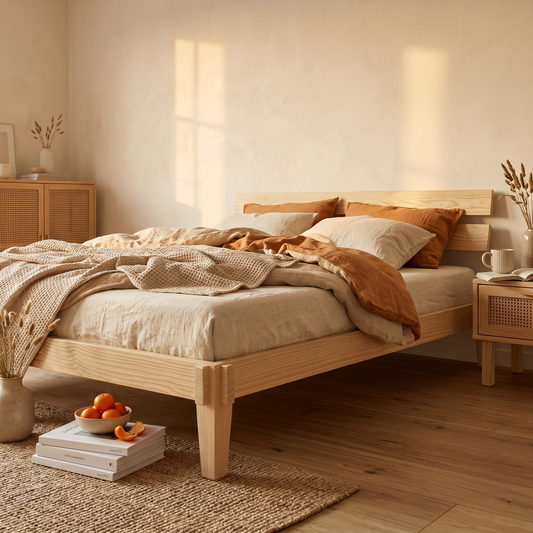
Pair the Akari Pinewood Mirror with the Poka Bed — solid pinewood, screwless joinery, matte finish — and the bedroom has a material coherence that is immediately felt even when it is not consciously noticed. Two pieces, the same wood, the same finish, the same intention.
The Long Mirror for Bedroom: Getting the Height Right
A long mirror for bedroom use that does not reach close to the floor misses the point of a full length mirror. The reflection should begin at or near floor level to show the complete outfit including footwear. A mirror that starts at knee height cuts off the most important part of the reflection for dressing purposes.
The ideal height for a full length floor mirror is between 150 and 180 cm. This range shows a complete reflection for most adults at a comfortable viewing distance, works proportionally in rooms with standard ceiling heights and provides enough vertical presence to function as a spatial anchor in the room.
Five Centuries of Usefulness
The standing mirror has survived five centuries of design evolution not because it is traditional but because it is correct. It solves a genuine human need — seeing yourself completely — with a simplicity that no alternative has improved upon. The materials have evolved. The form has been refined. The function is unchanged. In a world of objects that are constantly being replaced by something newer, the full length mirror is a reminder that some things are simply right.