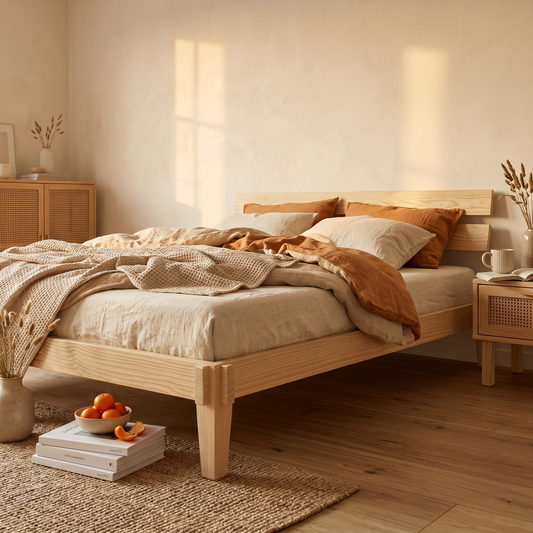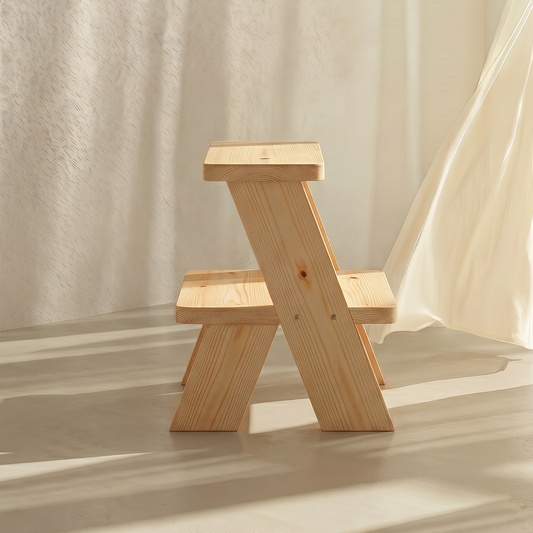

Sheesham dominates the traditional Indian bed market, while pine has grown popular in more minimalist, Japandi-style homes. The honest comparison isn't as one-sided as either side's marketing usually claims, so it's worth being precise about what each wood actually offers.
Sheesham's Real Strengths
Sheesham is a genuinely dense hardwood, grown and seasoned in Indian conditions, which gives it natural termite resistance and strong dimensional stability across monsoon humidity swings without much intervention. It also holds fine carving detail well, which is why it dominates traditional, heavier bed designs. A solid sheesham queen frame typically runs ₹20,000 to ₹1,20,000 depending on design and storage.
Where Pine Is Honestly Weaker, Untreated
It's worth being direct here: pine is a softwood, and untreated softwood genuinely does swell, warp, and degrade faster than dense hardwoods in humid tropical conditions. Any comparison that pretends pine is naturally as humidity-resistant as sheesham or teak isn't being straight with you.
Why Properly Processed Pine Still Works
The gap closes significantly with proper kiln-drying. Canadian pine, like the timber used in The Poka Bed, is kiln-dried to a stable 8 to 12 percent moisture content before it's ever built into furniture, a controlled process that pulls out the excess moisture responsible for most warping, then sealed with a finish that slows humidity absorption further. Interlocking joinery, rather than glue-and-screw construction, also matters more than the wood species alone, joints that accommodate natural wood movement fail far less often than rigid joints fighting it. Properly processed and joined, pine performs reliably in Indian conditions, the failures associated with softwood almost always trace back to skipping the drying and sealing step, not the species itself.
The Practical Differences That Remain
Pine is lighter and easier to move than dense sheesham, works better for a clean, minimal Japandi aesthetic than sheesham's heavier traditional grain, and generally costs 20 to 40 percent less for a comparable size and construction quality. Sheesham remains the safer default if you want maximum density with zero attention to finish maintenance over the years.
The Honest Verdict
Choose sheesham for a traditional, heavier aesthetic and the lowest-maintenance density available. Choose properly kiln-dried, well-joined pine for a lighter, more minimal look at a meaningfully lower price, understanding that its climate performance depends on construction quality, not on the species alone.