When people shop for a solid wooden bed online, they look at photographs, check dimensions and compare prices. Almost nobody asks about joinery. This is a significant oversight, because joinery is the single detail that most determines whether a solid wood bed frame stays solid for a decade or starts wobbling in year two.
Here is what joinery actually is, why it matters and how to tell the difference between furniture built to last and furniture built to look like it will.
What Joinery Means and Why It Is Not a Minor Detail
Joinery is the method by which two pieces of wood are connected. In furniture, there are three broad categories: mechanical joinery using bolts and screws, adhesive joinery using glue, and traditional joinery using interlocking wood geometry such as mortise-and-tenon, dovetail or dowel connections.
Each method has a different relationship with time, use and the seasonal movement of wood. Understanding this relationship is the difference between buying furniture that lasts and buying furniture that disappoints.
Bolt-Together Joinery: The Flat-Pack Standard
Bolt-together joinery is the dominant method in mid-range furniture. It is convenient for manufacturing and shipping — the pieces pack flat, the customer assembles at home and the brand saves significantly on logistics. For the customer, the convenience is real. The long-term performance is not.
The problem is mechanical. A bolt passes through a hole in the wood and is tightened against a surface. Over time, the wood fibres around the bolt hole compress under the repeated stress of use. The hole becomes slightly larger than the bolt. The joint develops micro-movement. The micro-movement becomes a wobble. The wobble cannot be fixed by re-tightening because the material that the bolt was gripping has already given way.
In a solid hardwood bed, this process takes longer than in an engineered wood frame. But it still happens. Bolt-together joinery in any material has a finite lifespan that is determined by the compression resistance of the material around the bolt hole.
Traditional Joinery: The Method That Gets Tighter With Use
Mortise-and-tenon joinery works on a completely different principle. A tenon — a projecting piece of wood — fits into a mortise — a corresponding cavity — in the adjoining piece. The joint is held by the geometry of the wood itself rather than by a mechanical fastener.
When wood absorbs moisture and expands slightly, a mortise-and-tenon joint gets tighter rather than looser. When it dries and contracts, it returns to its original fit. The joint accommodates the seasonal movement of the wood rather than fighting it. Over years of use, a well-made mortise-and-tenon joint becomes more stable, not less.
This is why traditional furniture made with this method survives for generations. It is not the wood alone that makes antique solid wooden beds structurally sound after a hundred years. It is the joinery.
Screwless Joinery in Modern Furniture
Screwless joinery is the contemporary application of traditional joinery principles. It eliminates visible hardware entirely — no bolts, no screws, no brackets — and holds the frame together through interlocking wood geometry. The result is a bed frame with no visible fasteners, no bolt holes to compress and no hardware to loosen.
From an aesthetic standpoint, screwless joinery produces a cleaner surface. There is nothing to interrupt the line of the wood. From a structural standpoint, it produces a frame that handles the seasonal movement of wood in Indian humidity without degrading. From a longevity standpoint, it produces furniture that does not have a built-in failure mechanism.
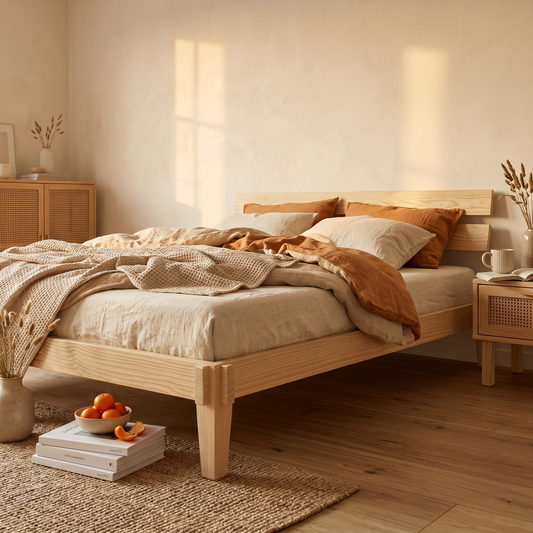
The Poka Bed by A Good Life uses screwless joinery throughout. The solid pinewood frame has no visible hardware and no bolt holes. The joints are held by the geometry of the wood, which means they accommodate the seasonal humidity cycling of an Indian bedroom without loosening. It is one of the details that is easy to overlook in a product listing and one of the most important for long-term structural integrity.
How to Identify Joinery Quality When You Buy Wooden Bed Online
When you cannot physically inspect a bed frame before purchasing, here is how to assess joinery quality from a product listing:
- Look for explicit joinery claims — A brand that uses screwless or mortise-and-tenon joinery will say so. If the listing does not mention joinery at all, assume bolt-together.
- Check the assembly instructions — If the bed requires tools and hardware to assemble, it is bolt-together. If it assembles without tools, it is likely traditional joinery.
- Ask directly — A brand confident in their joinery will answer this question immediately and specifically. Vague answers are informative.
- Look at the photographs carefully — Visible bolt heads or Allen key holes in the frame are a clear indicator of mechanical joinery.
The Mirror Connection
The same principle that makes joinery critical in a solid wooden bed applies to a wooden frame mirror. A full length floor mirror with a frame held together by staples or small screws will develop movement at the corners over time, particularly in a leaning configuration where the frame bears its own weight at an angle. A solid pinewood frame with proper joinery at the corners stays rigid indefinitely.
The Akari Pinewood Mirror is built with the same attention to frame construction as the Poka Bed. The solid pinewood frame is designed to hold its geometry as a leaning floor mirror without developing the corner movement that affects lesser frames. In a bedroom where both pieces are present, the structural consistency is as important as the visual one.
The Detail That Determines Everything
Joinery is not a feature. It is a foundation. Every other quality of a solid wooden bed — the wood species, the finish, the aesthetic — is built on top of the joinery. Get the joinery wrong and the rest does not matter. Get it right and you have furniture that will outlast the room it sits in.
When you next buy a wooden bed online, ask about the joinery before you ask about anything else. The answer will tell you more about the furniture than any photograph can.