
Proportion is the most powerful and least discussed element of interior design. A room can have beautiful furniture, a considered palette and excellent lighting and still feel wrong if the proportions are off. Conversely, a room with modest furniture and a limited budget can feel genuinely impressive if the proportions are right. Understanding proportion is the single design skill that produces the most significant improvement in a room for the least cost.
What Proportion Actually Means
Proportion in a room is the relationship between the size of the furniture and the size of the space. A piece of furniture that is correctly proportioned for a room fills the space with enough presence to anchor it without crowding it. A piece that is too small leaves dead space that makes the room feel unresolved. A piece that is too large crowds the space and makes it feel smaller than it is.
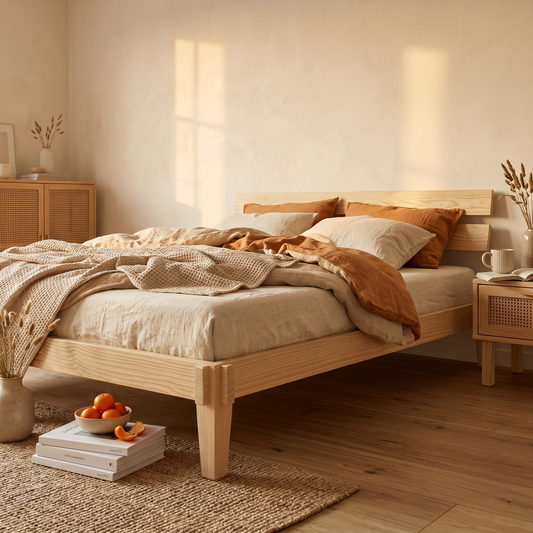
The bed is the most important proportional decision in a bedroom because it is the largest piece of furniture and the one that sets the proportional baseline for everything else. A bed that is correctly proportioned for the room makes the room feel designed. A bed that is too small or too large makes the room feel like it is waiting for the right furniture.
The Horizontal and Vertical Proportion
Proportion in a bedroom operates in two dimensions: horizontal and vertical. The horizontal proportion is determined by the bed — how wide the bed is relative to the room's width and how much clearance it leaves on each side. The vertical proportion is determined by the tallest element in the room — typically the mirror, a wardrobe or the headboard — and how it relates to the ceiling height.
A low-profile solid wooden bed with a full length floor mirror creates the ideal proportional balance in most bedrooms. The bed lowers the horizontal visual centre of gravity, which makes the ceiling feel higher. The mirror provides the vertical element that draws the eye upward, which amplifies the ceiling-height effect. The room feels both grounded and spacious simultaneously.
The King Size Bed Proportion Question
The king size bed is the right proportional choice for a room that is 12 by 14 feet or larger. In a room of this size, a king bed fills the space correctly and leaves adequate clearance on all sides. A double or queen bed in the same room leaves dead space that makes the room feel unresolved.
In a room that is 10 by 12 feet, a king bed crowds the space. The clearance on the sides is insufficient and the room feels smaller than it is. In this case, a double or queen bed is the proportionally correct choice.
The test is simple: map the footprint of the bed on the floor with newspaper or tape before you buy. Walk around it. Check the clearance on all sides. The proportional answer will be obvious.
The Poka Bed: Proportioned for the Indian Bedroom
The Poka Bed by A Good Life is available in multiple sizes and designed with a low profile that maximises the proportional quality of the bedroom. The low silhouette lowers the visual centre of gravity of the room, which makes the ceiling feel higher regardless of the room's actual dimensions. In a room with a standard 9-foot ceiling, the Poka Bed makes the ceiling feel like it is 11 feet.
Paired with the Akari Pinewood Mirror — a full length floor mirror that provides the vertical counterpoint to the low horizontal bed — the proportional balance of the bedroom is complete. The bed grounds the room. The mirror extends it. The room feels designed because the proportions are right.
Proportion as the Foundation of Design
Every other design decision in a room — the colour, the lighting, the textiles, the smaller objects — is built on top of the proportional foundation. Get the proportions right and the other decisions become easier. Get them wrong and no amount of styling fixes the fundamental imbalance. Proportion is not a detail. It is the foundation. Start there.