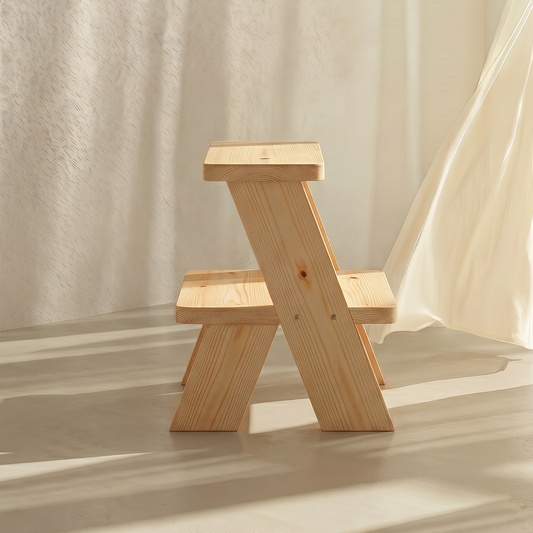

Standing directly on a piece of furniture puts a different kind of demand on it than sitting or resting objects on it, the load is more sudden, more concentrated, and less forgiving of weak joints.
Why Density Isn't the Full Story
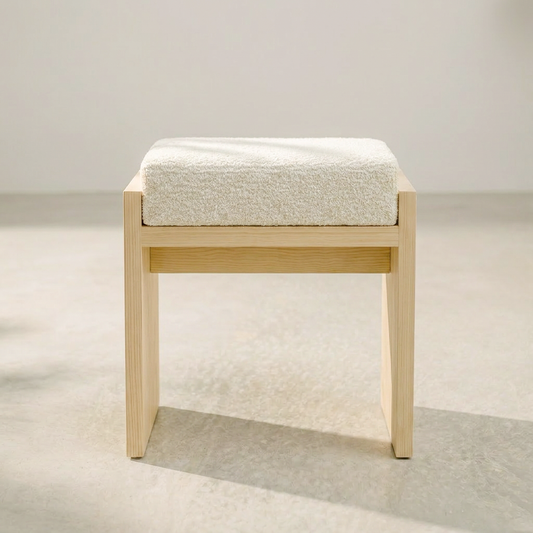
It's tempting to assume denser wood is automatically stronger for standing weight, but strength under sudden load depends as much on grain consistency and joinery as on density alone. Canadian pinewood, used in the Chibi Step Stool, has straight, predictable grain that distributes sudden weight evenly rather than concentrating stress at a single weak point.
Kiln-Drying Prevents the Real Failure Mode
Most step stool failures aren't the wood breaking outright, they're joints loosening after repeated stepping stress works them apart over time. Properly kiln-dried pine holds its dimensions under this repeated stress far better than improperly dried timber, which continues shrinking and loosening joints long after assembly.
Design Matters Alongside Material
A wider stance and a properly braced structure matter as much as wood choice for standing safety. The wood needs to be strong enough to support the design, but the design has to be engineered correctly in the first place.
The Honest Verdict
Canadian pinewood, properly dried and joined, handles standing weight reliably, not because it's the densest option available, but because its grain consistency and dimensional stability under repeated stress suit a piece built to be stepped on daily.