Every year, between June and September, Indian homes run an involuntary stress test on their furniture. Humidity climbs. Temperatures swing. And the furniture that looked fine in February begins to reveal what it is actually made of. Laminate lifts. Joints loosen. Drawer fronts warp just enough to stick. The monsoon does not break furniture. It reveals furniture that was never built for the conditions it was sold into.
Here is an honest look at how different materials perform in Indian humidity and what to look for when you buy wooden bed online or choose a full length mirror for a bedroom that will face four months of serious moisture every year.
Why Indian Humidity Is a Genuine Design Challenge
Mumbai's average relative humidity during monsoon exceeds 85 percent. Chennai, Kolkata and Kochi are similar. Even inland cities like Pune and Hyderabad see sustained humidity above 70 percent for months at a time. This is not a marginal condition. It is an extreme one by global furniture standards.
Furniture designed for European or North American conditions — where humidity rarely exceeds 60 percent — is not designed for this. The adhesives used in engineered wood, the laminates applied to MDF and the sealed lacquers on cheap solid wood furniture all behave differently at 85 percent humidity than they do at 50 percent. The difference is visible within a few monsoon seasons.
Engineered Wood: What Actually Happens
MDF and particleboard are made from compressed wood fibres and adhesives. At high humidity, the fibres absorb moisture and expand. The adhesive, which is not elastic, cannot accommodate this expansion uniformly. The result is swelling, particularly at edges and joints, followed by delamination as the laminate surface separates from the substrate beneath it.
This process is slow enough that it is easy to attribute to other causes. The drawer that sticks in July seems fine by October. The laminate that lifts at the corner of a bed frame looks like a manufacturing defect rather than a humidity response. But the cumulative effect over three or four monsoon cycles is irreversible. The furniture does not recover between seasons. It degrades incrementally until replacement is the only option.
Solid Wood: A Different Relationship With Moisture
Solid wood also absorbs moisture. This is not a flaw. It is a property. The difference is that solid wood absorbs and releases moisture as a single continuous piece, which means it moves uniformly. A solid wooden bed frame expands slightly in monsoon and contracts slightly in winter. The joints, if they are well-made, accommodate this movement without loosening.
Screwless joinery handles this particularly well. Because the joint is held by the geometry of the wood rather than by a bolt through a hole, the slight seasonal movement of the wood does not create the bolt-hole compression that causes wobble in bolt-together frames. A solid hardwood bed with screwless joinery will be as tight in year ten as it was in year one, even after a decade of Indian monsoons.
The finish matters enormously. A breathable matte oil or wax finish allows the wood to absorb and release moisture naturally. A sealed lacquer traps moisture inside the wood, which causes internal stress and eventually cracking or warping. When you buy wooden bed online, the finish type is one of the most important questions to ask and one of the least frequently answered in product listings.
Pinewood in Indian Humidity: The Honest Assessment
Pinewood is sometimes dismissed as unsuitable for Indian conditions because it is softer than sheesham or teak. This is a misunderstanding of what causes humidity-related furniture failure. Hardness is not the relevant variable. Moisture response and finish quality are.
Properly kiln-dried pinewood with a breathable matte oil finish performs well in Indian humidity. The kiln-drying process removes the moisture content that causes unseasoned wood to warp. The breathable finish allows the wood to manage seasonal moisture changes without stress. The result is a solid wooden bed that handles Indian conditions significantly better than any engineered wood alternative and comparably to sheesham at a lower weight and cost.
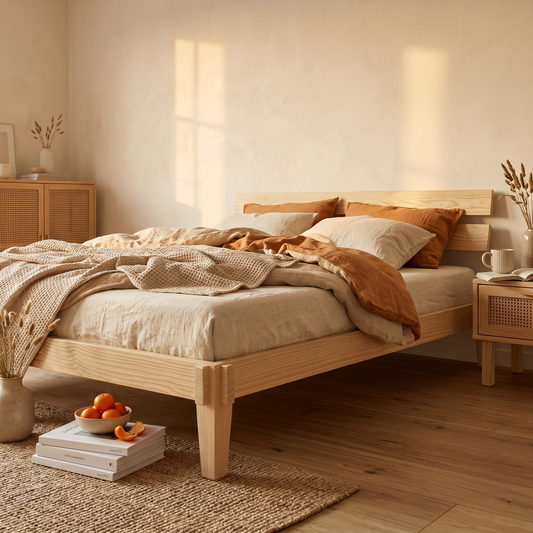
The Poka Bed by A Good Life is built from kiln-dried solid pinewood with a matte finish and screwless joinery. It is designed for the Indian bedroom as it actually exists — not the climate-controlled showroom version but the real one, with monsoon humidity, temperature swings and the expectation that furniture should last more than a few years.
Mirrors in Humidity: What to Watch For
Mirrors have their own humidity vulnerability. The silver backing of a mirror is susceptible to moisture penetration at the edges, which causes the characteristic black spotting known as desilvering. This is more common in bathrooms but can occur in bedrooms in very high humidity environments, particularly if the mirror is placed on an exterior wall.
A solid wood frame provides some protection by slowing moisture penetration at the edges. A plastic or MDF frame does not. The Akari Pinewood Mirror uses a solid pinewood frame that is more moisture-stable than engineered alternatives. As a leaning floor mirror rather than a wall-mounted one, it also avoids the wall condensation that can accelerate edge desilvering in high-humidity rooms.
The Practical Checklist for Monsoon-Ready Bedroom Furniture
- Material — Solid wood throughout, not veneered MDF. Confirm this explicitly before purchasing.
- Seasoning — Kiln-dried rather than air-dried. Kiln-drying removes moisture content more completely and consistently.
- Finish — Breathable matte oil or wax, not sealed lacquer. Ask specifically if the finish is breathable.
- Joinery — Screwless or mortise-and-tenon. Bolt-together joints loosen faster in humidity-cycling conditions.
- Placement — Keep solid wood furniture away from direct AC vents, which create rapid humidity cycling that stresses wood more than steady high humidity.
The Furniture That Earns Its Place
Indian conditions are demanding. The furniture that survives them is not the cheapest or the most expensive. It is the most honestly made. Solid wood, properly seasoned and finished, with joinery that accommodates seasonal movement, is the only category of bedroom furniture that consistently passes the monsoon test. Everything else is a temporary arrangement.