Most bedrooms are furnished piece by piece, each decision made independently of the others. A bed from one brand, a wardrobe from another, a mirror from a third, a rug from a fourth. The result is a room that is furnished but not designed — a collection of objects that coexist without speaking to each other. There is a different approach, and it requires only two pieces to work.
The Two-Piece Bedroom
A bedroom can be defined by two objects: the bed and the mirror. These are the two largest, most visually significant pieces in most bedrooms. The bed is the horizontal anchor — the piece that determines the proportional baseline and the material tone of the room. The mirror is the vertical anchor — the piece that extends the room's perceived height, reflects its depth and provides the daily functional reflection that no other object can.
When these two pieces share a material language — the same wood species, the same finish type, the same design philosophy — the room feels designed rather than assembled. Everything else in the room — the textiles, the lighting, the rug, the smaller objects — is evaluated against the material language established by these two pieces. The room has a coherence that is immediately felt even when it is not consciously noticed.
Why Material Continuity Matters More Than Matching
Material continuity is not the same as matching. Matching means identical — the same colour, the same finish, the same style. Material continuity means belonging to the same family — the same material, the same finish type, the same aesthetic register. A solid pinewood bed and a solid pinewood mirror are not identical objects. One is structural and horizontal. The other is reflective and vertical. But they are made from the same material with the same finish, which means they speak the same language.
In a room where the two largest pieces speak the same language, the smaller pieces have a clear context to fit into. Linen textiles in warm white belong to the same natural material family as solid pinewood. A wool rug in a stone tone belongs to the same warm neutral palette. A warm lamp in a natural material belongs to the same aesthetic register. The room builds itself around the material language established by the bed and the mirror.
The Horizontal and the Vertical
A bedroom needs both horizontal and vertical anchors to feel proportionally resolved. The bed provides the horizontal anchor — a wide, low presence that grounds the room and gives it a visual centre of gravity. Without a vertical anchor, the room feels wide but not tall, grounded but not spacious.
A full length floor mirror provides the vertical anchor. Its height draws the eye upward, which makes the ceiling feel higher. Its reflection extends the room's perceived depth, which makes the space feel larger. Together, the low horizontal bed and the tall vertical mirror create a room that feels both grounded and spacious — the proportional ideal for a bedroom.
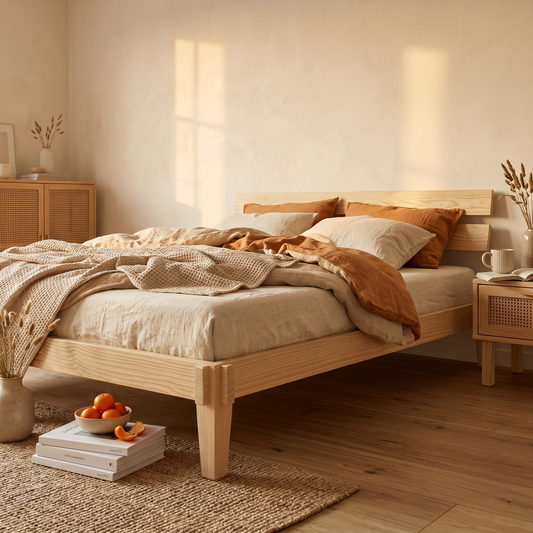
The Poka Bed by A Good Life is the horizontal anchor. Solid pinewood, screwless joinery, a low Japandi silhouette and a matte finish that absorbs light rather than reflecting it. It sits close to the ground and reads as wide and settled. The Akari Pinewood Mirror is the vertical anchor. Solid pinewood, matte finish, a full length leaning format that draws the eye from floor to near-ceiling. Together, they define the room's proportional and material character.
What the Rest of the Room Does
Once the bed and the mirror are in place, the rest of the room's furnishing becomes significantly easier. The material language is established. The proportional anchors are set. The remaining decisions — textiles, lighting, rug, smaller objects — are made in relation to a clear framework rather than in isolation.
Linen duvet cover in warm white. Wool throw in stone or sand. Bedside lamps in warm natural materials. A rug that extends under the bed and beyond it on all sides. A small plant at the base of the mirror. These are not difficult decisions when the framework is clear. They are the natural completion of a room that has already been defined by its two anchors.
The Room That Builds Itself
A bedroom defined by a solid wooden bed and a full length floor mirror in the same material does not need to be designed in detail. It needs to be started correctly. The two anchors establish the material language, the proportional framework and the aesthetic register. Everything else follows. The room builds itself around the decisions you have already made.
This is the most efficient approach to bedroom design available. Not ten decisions made independently, each one potentially working against the others. Two decisions made together, each one reinforcing the other, and a room that feels designed from the first piece placed to the last.
Two Pieces. One Room. One Decision.
The Poka Bed and the Akari Pinewood Mirror are made from the same solid pinewood with the same matte finish and the same design philosophy. They are not a matched set in the sense of being identical. They are a coherent pair in the sense of belonging to the same material family and serving complementary spatial functions. In a bedroom, this coherence is the difference between a room that looks like it was designed and one that looks like it was furnished. Choose the two pieces that define the room. Let everything else follow.