The minimalist bedroom is one of the most searched and least achieved bedroom aesthetics. Most attempts at minimalism produce a room that feels empty rather than calm, stripped rather than considered. The difference between a minimalist bedroom that works and one that does not is not the number of objects. It is the quality and function of the objects that remain. And in a bedroom, a single full length mirror does more spatial, aesthetic and functional work than almost any other object you could choose.
What Minimalism Actually Means in a Bedroom
Minimalism is not the absence of objects. It is the presence of only the right objects. A minimalist bedroom has everything it needs and nothing it does not. The bed. The textiles. The lighting. The mirror. These are the functional anchors of a bedroom. Everything else is optional and should earn its place by contributing something that these anchors cannot.
Decorative objects — vases, sculptures, framed prints, collections of small things on surfaces — contribute visual interest. But visual interest is not the same as spatial quality, material honesty or functional value. A full length floor mirror contributes all three simultaneously. It reflects the room, which improves its spatial quality. It is made from a natural material, which contributes to the material honesty of the space. And it serves a clear daily function that no decorative object can replicate.
The Spatial Work a Full Length Mirror Does
A full length mirror in the right position reflects the room's depth, amplifies its natural light and makes the space feel larger than its dimensions. No decorative object does any of these things. A vase on a shelf adds visual interest but reduces the perceived floor space. A framed print on a wall adds colour but does nothing for the room's proportions. A collection of objects on a surface adds personality but increases visual complexity, which works against the calm that a minimalist bedroom is trying to achieve.
A full length floor mirror, by contrast, reduces visual complexity by reflecting the room rather than adding to it. The reflection is the room itself, which means the mirror adds depth without adding objects. In a minimalist bedroom, this is the most valuable spatial contribution available.
The Functional Work a Full Length Mirror Does
A full length mirror for bedroom use serves a clear daily function: it shows you your complete reflection before you leave the room. This function cannot be served by a smaller mirror, a decorative object or an empty wall. It requires a specific object in a specific size. In a minimalist bedroom where every object must earn its place, the full length mirror earns its place more completely than almost anything else.
The standing mirror for bedroom use also serves a secondary function: it tells you about the room. Standing in front of a full length mirror and looking at the room reflected behind you gives you the most honest assessment of the room's visual quality available. If the room looks calm and considered in the reflection, it is working. If it looks cluttered or unresolved, something needs to change. The mirror is both a functional object and a diagnostic tool.
The Material Work a Full Length Mirror Does
In a minimalist bedroom built around natural materials, a wooden frame mirror in solid pinewood contributes to the material language of the space in a way that a decorative object rarely does. The frame is made from the same material family as the solid wooden bed, the linen textiles and the natural palette. It belongs to the room rather than sitting in it.
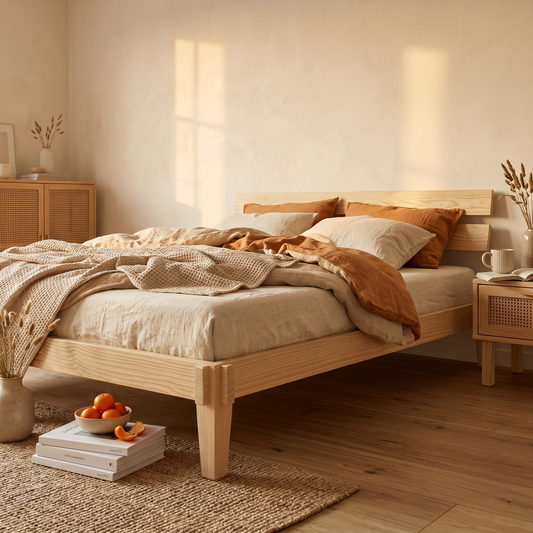
The Akari Pinewood Mirror is a full length floor mirror in solid pinewood with a matte finish. In a minimalist bedroom, it is one of the two or three objects that anchor the space. The other is the bed. The Poka Bed in solid pinewood with screwless joinery and a low Japandi silhouette is the horizontal anchor. The Akari Mirror is the vertical one. Together, they define the room without filling it.
Why Ten Decorative Objects Cannot Do What One Mirror Does
Ten decorative objects add ten points of visual interest. They also add ten points of visual complexity, ten surfaces to dust, ten decisions about arrangement and ten objects that will need to be reconsidered when the room is redecorated. A full length mirror adds one point of visual interest, zero visual complexity — because it reflects the room rather than adding to it — one surface to clean and one object that works in any room regardless of the palette or the other furniture.
The mathematics of minimalism favour the mirror. It does more with less. It contributes more to the room's spatial quality, material honesty and functional value than any equivalent number of decorative objects. In a bedroom where every object must earn its place, the full length mirror earns its place more completely than anything else you could put in the room.
The Minimalist Bedroom That Actually Works
A minimalist bedroom that works has a solid wooden bed, natural textiles, warm layered lighting and a full length floor mirror in the right position. It does not have ten decorative objects competing for attention. It has the objects that do the most work and nothing that does not. The calm it produces is not the calm of emptiness. It is the calm of sufficiency — a room that has exactly what it needs and nothing more.