
Walk into any furniture store in India and you will find two very different ideas of what a wooden bed should look like. On one side: the traditional wooden bed — heavy, ornate, high off the ground, carved headboard, dark polish. On the other: the modern wooden bed — low, clean, quiet, built around the wood itself rather than decoration applied on top of it.
Both are made from wood. Both can last a lifetime. But they come from entirely different design philosophies — and they create entirely different feelings in a room.
If you are trying to decide which to choose when you buy a wooden bed online, this comparison will help you think it through clearly.
What Is a Traditional Wooden Bed?
The traditional Indian wooden bed — often made from sheesham or teak — is built around presence. High headboards, sometimes carved. Dark finishes, often lacquered. A platform height of 20 inches or more. Decorative detailing on the legs and frame.
It is furniture that announces itself. In a large, traditionally furnished room, it works beautifully. It carries a sense of permanence and formality that suits certain homes and certain aesthetics.
But in a modern Indian apartment — where rooms are smaller, ceilings are lower and the design language is moving toward calm and simplicity — a heavy, high traditional bed can make the room feel crowded and closed in.
What Is a Japandi Bed?
A Japandi bed comes from the design philosophy that blends Japanese minimalism with Scandinavian warmth. The result is furniture that is quiet, grounded and built around the honest beauty of natural materials.
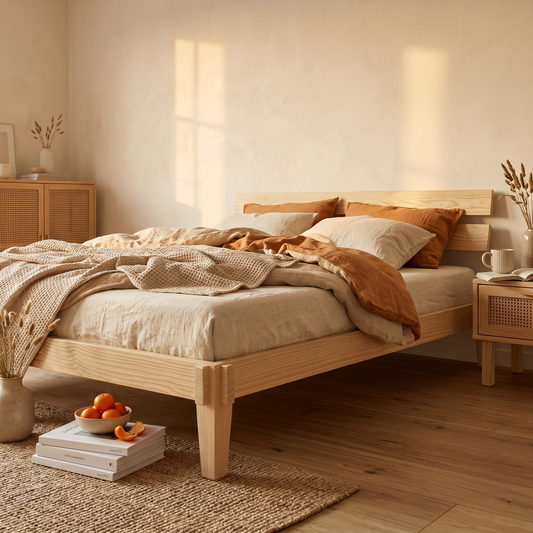
A Japandi wooden bed frame typically sits low to the ground — between 12 and 18 inches. The lines are clean and undecorated. The wood is left to speak for itself: its grain, its warmth, its natural variation. There is no carving, no dark lacquer, no hardware on display. Just the material and the form.
In a room, a Japandi bed does something a traditional bed rarely does: it makes the space feel larger. The low profile draws the eye outward. The light wood tone reflects rather than absorbs. The absence of visual clutter lets the room breathe.
The Key Differences at a Glance
Height and Proportion
Traditional: High platform, often 20"+ from floor to top of mattress. Visually dominant, suits large rooms.
Japandi: Low profile, typically 14–18" total height. Visually recessive, suits rooms of all sizes — especially compact ones.
Wood and Finish
Traditional: Often sheesham or teak with a dark polish or lacquer finish. Rich and formal.
Japandi: Often pinewood, oak or ash with a natural or light matte finish. Warm and understated.
Joinery and Construction
Traditional: Typically bolt-and-screw assembly with decorative hardware visible on the frame.
Japandi: Minimal or screwless joinery — the construction is part of the design, not hidden behind decoration.
Design Language
Traditional: Ornate, carved, detailed. The bed is the centrepiece of the room.
Modern wooden bed (Japandi): Clean, undecorated, intentional. The bed anchors the room without dominating it.
Longevity of Style
Traditional: Timeless within its own aesthetic — but difficult to pair with contemporary interiors.
Japandi: Genuinely timeless — works with minimalist, Scandinavian, wabi-sabi, contemporary and even transitional interiors.
Which One Is Right for Your Bedroom?
Choose a traditional wooden bed if your home has large rooms, high ceilings and a classically furnished aesthetic — and if you want furniture that makes a bold, formal statement.
Choose a Japandi bed if you want a bedroom that feels calm, open and considered. If your room is compact. If you are drawn to natural materials and clean lines. If you want a modern wooden bed that will still feel relevant in ten years — and will work with almost any interior direction you take in the future.
For most contemporary Indian homes, the Japandi approach is simply the smarter long-term investment.
The Poka Bed: A Modern Wooden Bed Built for the Long Term
The Poka Bed by A Good Life is our answer to the question of what a Japandi bed should feel like in an Indian home.
Named after poka poka (ポカポカ) — the Japanese word for gentle, enveloping warmth — it is handcrafted from solid Canadian pinewood with a screwless joinery system and a low, grounded silhouette that makes any bedroom feel more open and more settled.
What Makes It Different
- Solid Canadian pinewood — no MDF, no veneers, no shortcuts
- Screwless joinery — interlocking panels, no visible hardware, no wobble over time
- 15.5" height — low and grounded, opens up the room visually
- Natural matte finish — the grain is the design
- Hand-made — slight natural variation in texture and tone is expected and intentional
Sizes and Pricing
- King: 78" (L) × 81" (W) × 15.5" (H) — fits a 75" × 72" mattress — ₹98,490
- Queen: 78" (L) × 72" (W) × 15.5" (H) — fits a 72" × 66" mattress — ₹98,490
- Custom sizes available — write to hello@agoodlife.in
Ships flat-packed across India within 2 weeks.
A Final Thought
The best wooden bed frame is not the most expensive one or the most decorated one. It is the one that makes your bedroom feel the way you want to feel when you walk into it.
If that feeling is calm, warm and quietly considered — a modern wooden bed in the Japandi tradition is where to start.
Questions? Write to us at hello@agoodlife.in.