For about two decades, the Indian furniture market moved steadily toward engineered wood. It was cheaper to manufacture, easier to ship flat-packed and simpler to assemble. Brands built entire business models around it. Consumers accepted it as the default. And then, quietly, something shifted.
Solid wood furniture is growing again in India — not as a luxury category but as a considered choice by buyers who have lived with engineered wood long enough to understand its limitations. Here is what is driving that shift and what it means for how you furnish your bedroom.
What Changed in the Indian Consumer
The generation now furnishing homes in India's metros grew up watching engineered wood furniture degrade. They saw their parents' MDF wardrobes swell in monsoon humidity. They watched laminate peel at the edges of beds that were only three years old. They experienced the particular frustration of a bolt-together frame that cannot be re-tightened because the material around the bolt hole has given way.
This is not nostalgia for solid wood. It is a rational response to lived experience. When you have seen what happens to cheap furniture over time, the calculus on a solid wooden bed changes. The higher upfront cost looks different when you factor in the replacement cycle.
The Humidity Factor
India's climate is one of the most demanding environments for furniture in the world. Monsoon humidity in coastal and central cities regularly exceeds 80 percent. Engineered wood, which is made from compressed fibres and adhesives, absorbs moisture unevenly and swells, warps and delaminates under these conditions.
Solid wood behaves differently. It absorbs and releases moisture as a single piece, which means it moves uniformly rather than warping. A solid hardwood bed or solid wooden bedframe that is properly finished with a breathable matte oil will handle Indian humidity significantly better than an MDF frame sealed under lacquer, which traps moisture rather than managing it.
Pinewood, in particular, has a moisture response profile that suits Indian conditions well. It is not as dense as sheesham or teak, which means it is not as heavy, but it is stable enough for bedroom furniture in most Indian climates when properly seasoned and finished.
The Aesthetic Shift
The Japandi bedroom aesthetic has found a particularly receptive audience in India. The combination of Japanese wabi-sabi and Scandinavian hygge — natural materials, warm neutrals, intentional simplicity — maps well onto a cultural preference for warmth and craft that was always present in Indian design but had been suppressed by the dominance of Western-influenced contemporary furniture.
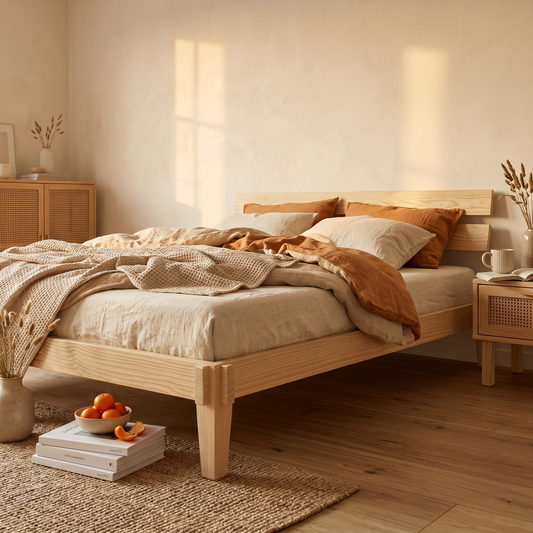
A Japandi bed in solid pinewood, low to the ground with clean lines and no visible hardware, looks at home in a Mumbai apartment or a Bangalore villa in a way that a high-gloss Italian-influenced bedroom set does not. The material is honest. The aesthetic is calm. The craft is visible.
The Poka Bed by A Good Life sits squarely in this moment. Solid pinewood, screwless joinery, a low Japandi silhouette and a matte finish that ages rather than degrades. It is a bed designed for the Indian bedroom as it is actually lived in, not as it appears in a European catalogue.
The Full Length Mirror as a Design Statement
The full length mirror has always been a bedroom staple in India. What has changed is the frame. The ornate carved frames of traditional Indian furniture and the chrome-edged frames of 2000s contemporary design are both giving way to something quieter: a wooden frame mirror in natural pinewood or similar materials that reads as warm without being decorative.
A standing mirror for bedroom use in solid pinewood occupies a different visual register from its predecessors. It is not trying to be a statement piece. It is trying to be a good object — functional, well-made and honest about its material. The Akari Pinewood Mirror is exactly this. A full length floor mirror that leans, reflects and ages well without demanding attention.
What Solid Wood Furniture Costs in India Now
The price gap between solid wood and engineered wood furniture has narrowed significantly in the last five years. Improved supply chains, domestic manufacturing and growing demand have all contributed. A solid wooden bed in pinewood is no longer the exclusive purchase it was a decade ago.
King bed prices for solid wood frames now sit in a range that is accessible to the urban middle class, particularly when the cost is amortised over the expected lifespan of the furniture. A solid wood bed frame that lasts fifteen years at a higher price point costs less per year than an engineered wood frame replaced every four to five years.
The Brands Getting It Right
The Indian furniture brands doing the most interesting work right now are the ones that have rejected the flat-pack model entirely. They are making furniture in solid wood with traditional joinery methods, finishing it with breathable oils rather than sealed lacquers and selling it with the transparency about materials and process that the new Indian consumer is asking for.
This is not a niche. It is a direction. The Indian bedroom in 2025 is moving toward natural materials, honest craft and furniture that is built to last. Solid wood is not making a comeback because it is fashionable. It is making a comeback because it is right.