
"Solid wood" is one of the most overused phrases in furniture retail, applied loosely enough that it often tells you almost nothing about what you're actually buying. The good news is that verifying the claim doesn't require a lab, just a handful of checks anyone can do in a showroom or from a few close-up photos online.
Start With the Grain
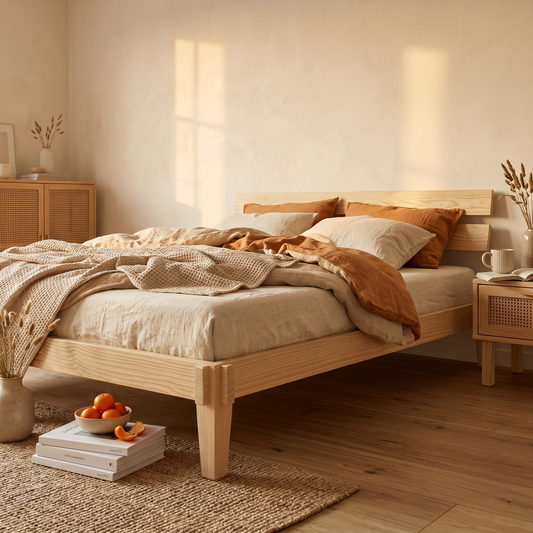
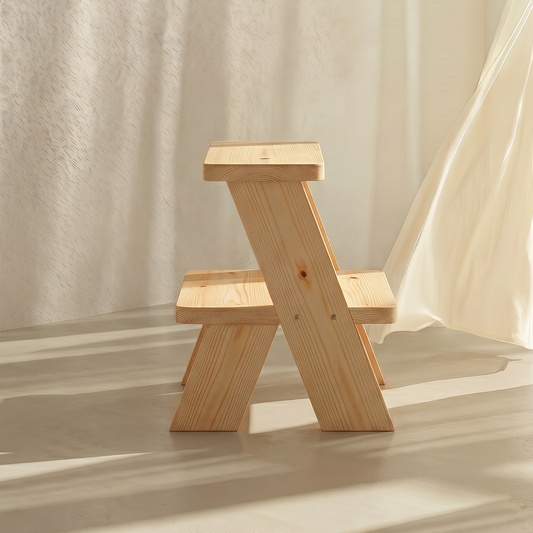
Solid timber is cut from a single piece of wood, so its grain runs continuously, following the same natural pattern across the top surface, down the edge, and onto the underside, because it's all one material. Veneer, by contrast, is a thin slice of real wood, sometimes barely a millimetre thick, glued onto a core of MDF or particleboard. The giveaway is at the edge: if the grain pattern on top abruptly stops or changes at a corner, or if the edge shows a different, duller material beneath a thin decorative layer, you're looking at veneer over a composite core, not solid timber. On The Poka Bed, the grain runs unbroken from the headboard face straight through to its edge, exactly what genuine solid pinewood construction looks like.
Weight Doesn't Lie
Solid wood is dense and noticeably heavy for its size, engineered wood is deliberately lighter, since compressed fibre and resin weigh less than an equivalent volume of real timber. If a bed frame advertised as solid wood feels suspiciously easy to lift or shift on your own, that's a legitimate reason to ask more questions before buying.
Check How It's Joined
Genuine solid wood furniture can support real joinery, dovetails, mortise and tenon, or interlocking joints cut directly into the timber, because there's enough material depth to carve into. Composite cores generally can't hold this kind of joinery without cracking, so manufacturers rely on screws, cam locks, or staples instead. A frame built the way The Poka Bed is, with interlocking wood joints rather than metal hardware, is a strong practical signal that real timber sits underneath, not just a decorative wood-look surface.
Solid Wood Moves, and That's Normal
Real timber expands and contracts slightly with seasonal humidity, a completely normal characteristic that good joinery is designed to accommodate. Furniture that's rigidly, perfectly fixed in every direction with no allowance for this movement is often a sign of composite construction underneath a convincing finish, since engineered boards don't move the way natural wood does.
The Air Quality Angle Most Buyers Miss
Beyond appearance, there's a genuine health dimension to this question. Composite wood products like particleboard and MDF are typically bonded with urea-formaldehyde resins, and these adhesives can off-gas formaldehyde into a room for months after the furniture arrives, with emissions typically highest in the first six to twelve months. Formaldehyde exposure at elevated levels is linked to eye, nose, and throat irritation, and prolonged exposure has been studied for more serious long-term effects. Genuinely solid wood, without a composite core, contains only trace natural formaldehyde and doesn't carry this same adhesive-driven emission profile, particularly when finished with a simple oil rather than a heavy synthetic lacquer.
Let Price Confirm What You've Already Seen
Solid timber costs more to source and machine than composite board, and building it properly takes longer. Price alone isn't proof of anything, but a "solid wood" bed priced dramatically below the market range for genuine timber construction is usually explained by one of the shortcuts above, a veneer surface, a composite core, or corners cut on joinery. Use price as a final sanity check after you've already inspected grain, weight, and joints, not as the primary test.
The Honest Verdict
No single check is fully conclusive on its own, but grain continuity, weight, joinery, and a willingness to move naturally with humidity, taken together, reliably separate genuine solid wood from a well-disguised composite. Ask to see an edge, a joint, or the underside before you buy, any maker confident in their construction will show you without hesitation.