Most bedroom styling advice starts in the wrong place. It begins with colour palettes, accent pillows and decorative objects — the finishing layer — before the foundational decisions have been made. The result is a room that looks styled but does not feel resolved. Here is the sequence that actually works, from the first decision to the last.
Step One: Decide the Feeling Before You Decide Anything Else
Before you choose a bed frame, a colour or a mirror, decide how you want the room to feel. Not how it should look — how it should feel. Calm and grounded? Warm and enveloping? Light and airy? The feeling is the brief. Every subsequent decision is evaluated against it.
For most people who are drawn to natural materials and considered design, the feeling they are after is some version of calm. A room that slows the mind when you enter it. A room that feels like a deliberate choice rather than an accumulation of purchases. This feeling has a design language: low furniture, natural materials, a restrained palette, visual quiet. It is the Japandi bedroom aesthetic, and it is achievable in an Indian home without a designer or a large budget.
Step Two: Choose the Bed Frame First
The bed is the largest object in the bedroom. It sets the proportional baseline, the material tone and the aesthetic register for everything else. Choose it first and choose it carefully, because every subsequent decision will be made in relation to it.
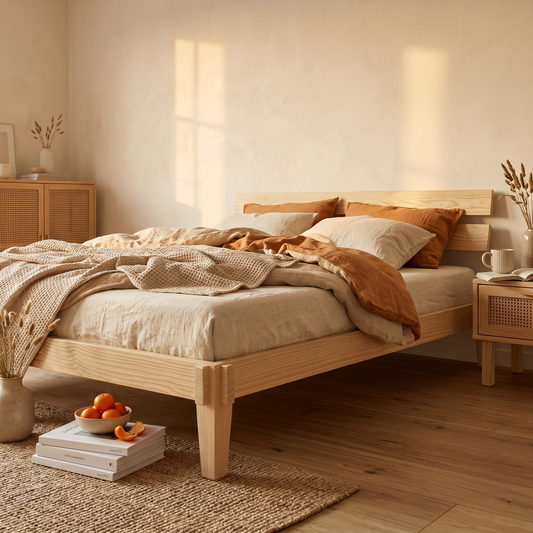
For a calm, grounded bedroom, the criteria are specific. Low profile. Solid wood. Matte finish. No visible hardware. A king size bed frame if the room supports it proportionally, a smaller format if it does not. The bed should feel settled in the room — present without being dominant, structural without being heavy.
The Poka Bed by A Good Life meets these criteria precisely. Solid pinewood, screwless joinery, a low Japandi silhouette and a matte finish that absorbs light rather than reflecting it. It is the right starting point for a bedroom built around natural materials and visual calm.
Step Three: Fix the Palette Around the Wood
Once the bed frame is chosen, the palette follows from the wood. Solid pinewood is warm and light — a honey-to-cream tone that reads as neutral without being cold. The palette that works with it is drawn from the same natural spectrum: warm white, sand, stone, linen, soft terracotta. These are not trendy colours. They are the colours of natural materials, which means they do not date.
Avoid cool greys, stark whites and anything with a blue or green undertone alongside natural pinewood. These create a visual tension between the warmth of the wood and the coolness of the palette that makes the room feel unresolved even when it is tidy.
Step Four: Choose the Textiles
Textiles are the acoustic and tactile layer of the bedroom. They absorb sound, regulate temperature and determine how the room feels to be in rather than just to look at. Natural textiles — linen, cotton, wool — are the right choice for a bedroom built around natural materials. They breathe, they soften with washing and they age in the same direction as solid wood: better rather than worse.
A linen duvet cover in warm white or natural undyed linen is the single textile decision that does the most work in a Japandi bedroom. It is visually quiet, tactilely comfortable and consistent with the material language of a solid wooden bed. Add a wool or cotton throw in a stone or sand tone and the textile layer is essentially complete.
Step Five: Place the Mirror
The mirror comes after the bed and the textiles because its placement depends on the room as it is actually configured, not as it is imagined. A full length mirror or standing mirror for bedroom use should be positioned to reflect light rather than walls, to add depth rather than duplication and to be practical for daily use without disrupting sleep.
The adjacent-to-window placement works in most bedrooms. The mirror catches natural light and reflects it into the room, which makes the space feel larger and brighter without any structural change. A leaning floor mirror gives you the flexibility to find this position through iteration rather than committing to a wall mounting before you are certain.
The Akari Pinewood Mirror is a full length floor mirror in solid pinewood that leans without wall fixings. The solid pinewood frame matches the material language of the Poka Bed, which means the two pieces create material continuity without being a matched set. In a bedroom built around natural materials, this continuity is what makes the room feel considered rather than assembled.
Step Six: Add Light in Layers
Overhead lighting flattens a bedroom. A single ceiling light at full brightness is the least flattering and least restful lighting condition available. Replace it with layered lighting at different heights: a warm bedside lamp on each side of the bed, a floor lamp in a corner if the room is large enough and the overhead light used only for cleaning and practical tasks rather than for ambience.
Warm bulbs — 2700K or lower — are essential. Cool white light suppresses melatonin and delays sleep onset. Warm light does the opposite. This is one of the cheapest and most effective changes you can make to a bedroom's sleep quality.
Step Seven: Edit Rather Than Add
The final step in styling a bedroom from scratch is not adding the last few objects. It is removing the ones that do not belong. Walk into the room after completing steps one through six and look at it with fresh eyes. Anything that creates visual noise, anything that does not serve a clear function and anything that does not belong to the material language of the room should be removed.
A bedroom styled by subtraction feels more resolved than one styled by addition. The objects that remain earn their place precisely because the ones that did not earn it are gone. This is the Japandi principle in practice: not minimalism, but intentionality. Every object chosen. Nothing accumulated.
The Room You Meant to Have
Styling a bedroom from scratch is not a design project. It is a series of decisions made in the right order. Get the sequence right and the room resolves itself. Get it wrong and no amount of styling fixes the foundational problems. Start with the bed. Everything else follows.