
Small bedrooms are one of the most common design challenges in Indian homes. Urban apartments, older construction and the simple reality of land costs mean that many master bedrooms are working with 100 to 130 square feet rather than the 180 to 200 that would make everything easier. The good news is that perceived space and actual space are not the same thing. A well-considered bedroom can feel significantly larger than its measurements suggest. Here is how.
The Biggest Mistake in Small Bedrooms
The most common mistake in a small bedroom is choosing furniture that is too small. This sounds counterintuitive. Surely a smaller bed leaves more floor space and makes the room feel larger? In practice, the opposite is usually true.
A bed that is undersized for the room creates awkward negative space around it — gaps that are too small to use but too large to ignore. The room looks unresolved. The eye has nowhere to rest. The result is a space that feels cluttered even when it is not.
The correct approach is to choose furniture that is proportionally right for the room, even if that means a larger piece than you expected. A king size bed in a room that can accommodate it will make the room feel more intentional and more spacious than a double bed surrounded by dead space.
Low Furniture and the Ceiling Effect
In a room with a standard 9 or 10-foot ceiling, the height of your furniture determines how tall the room feels. High furniture — tall wardrobes, high headboards, stacked storage — compresses the visual space between the furniture top and the ceiling. Low furniture does the opposite. It leaves the upper portion of the room open, which makes the ceiling feel higher than it is.
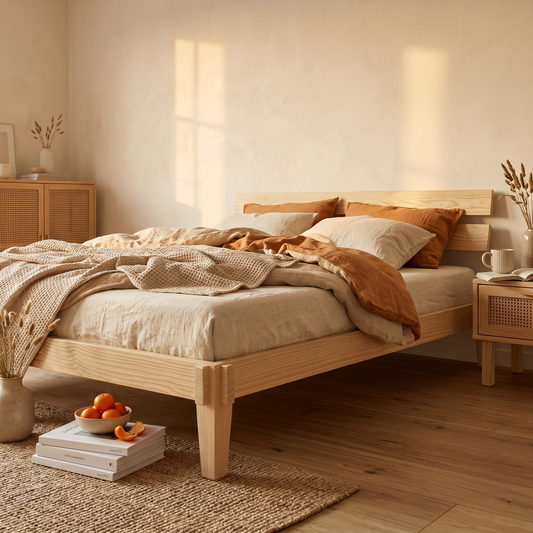
A Japandi bed with a low profile is one of the most effective tools for making a small bedroom feel taller. The Poka Bed by A Good Life sits close to the ground with a clean, low silhouette. In a small bedroom, this single choice can make the room feel meaningfully more spacious without changing anything else. The solid pinewood frame also keeps the visual weight light — pale wood reads as less heavy than dark wood in a confined space.
The Full Length Mirror: The Most Effective Space Tool Available
A full length mirror is the single most effective non-structural intervention for making a small room feel larger. The physics are straightforward: a large mirror reflects the room back at you, visually doubling the perceived depth of the space. A full size mirror or full length floor mirror positioned correctly can make a 100-square-foot bedroom feel like 150.
The key word is correctly. A mirror facing a wall reflects the wall and does nothing for the room. A mirror positioned to reflect a window, a light source or the depth of the room creates genuine spatial expansion. In a small bedroom, the best position for a standing mirror or leaning floor mirror is usually on the wall adjacent to the window, angled slightly to catch the light and reflect the room's longest dimension.
The Akari Pinewood Mirror is a full length floor mirror in solid pinewood that leans without wall fixings. In a small bedroom, this is particularly useful because it can be repositioned easily until you find the placement that works best. The solid pinewood frame keeps the mirror visually light — a heavy ornate frame in a small room adds visual weight that works against the spaciousness you are trying to create.
Colour, Light and the Perception of Space
Colour affects perceived space more than most people realise. Light, warm neutrals — warm white, sand, stone — reflect light and make walls feel further away. Dark colours absorb light and bring walls closer. In a small bedroom, the palette should be drawn from the lighter end of the natural spectrum.
Natural light amplifies everything. A small bedroom with good natural light and a full length mirror to reflect it will feel larger than a bigger bedroom with poor light. If your bedroom has limited windows, prioritise warm artificial lighting at low levels rather than a single bright overhead source. Overhead lighting flattens a room. Layered warm lighting at different heights creates depth.
The Floor Rule
Visible floor space makes a room feel larger. Every piece of furniture that sits on legs rather than sitting flat on the floor reveals floor beneath it, which extends the perceived floor area. A solid wood bed frame on legs, a bedside table on legs and a leaning mirror rather than a floor-to-ceiling wardrobe all contribute to this effect.
Keep the floor clear of objects wherever possible. A rug that is too small for the space — a common mistake — fragments the floor visually and makes the room feel smaller. A rug that extends under the bed and beyond it on all sides unifies the floor and makes the room feel larger.
What to Remove Before You Add Anything
In a small bedroom, subtraction is more powerful than addition. Before buying anything new, remove everything that does not serve a clear function. Decorative objects that sit on surfaces, extra pillows that are never used, furniture that holds things you could store elsewhere — all of these reduce the perceived space of the room without contributing to how it functions.
A small bedroom with a well-chosen solid wooden bed, a full length mirror and clear surfaces will feel more spacious than the same room filled with smaller, cheaper furniture and accumulated objects. The discipline of choosing less is the most underused tool in small bedroom design.
The Room You Have Is Enough
Small bedrooms are not a problem to be solved by moving to a larger home. They are a design challenge that rewards intentionality. The right bed frame, the right mirror placement and the right palette can transform a room that feels cramped into one that feels considered. The square footage does not change. The experience of it does.