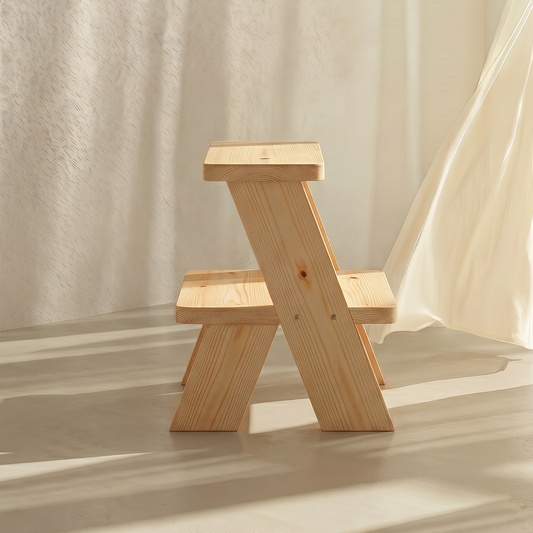
The homes that feel most like the people who live in them are rarely the most expensively furnished. They are the most coherently furnished. There is a quality to a home where every piece belongs to the same material family — where the wood in the bedroom is the same wood in the entryway, where the finish on the mirror matches the finish on the console, where the design philosophy is consistent from the front door to the bedroom wall. This quality is not luxury. It is intention. And it is more achievable than most people think.
Why Most Homes Feel Like Nobody in Particular
Most homes are furnished through a process of accumulation rather than intention. A piece is bought because it is needed. Another because it is on sale. Another because it looked good in a photograph. Each decision is made independently, without reference to a material language or a design philosophy. The result is a home that is full of objects that each made sense individually but do not make sense together.
This is not a taste problem. It is a framework problem. Without a clear material language — a defined set of materials, finishes and aesthetic principles that every purchase is evaluated against — every decision is made in isolation and the home never coheres. The solution is not to buy more carefully chosen objects. It is to define the framework first and let every purchase follow from it.
Defining a Material Language
A material language is simpler than it sounds. It is the answer to three questions: what material, what finish and what aesthetic register? For a home built around natural materials and visual calm, the answers might be solid pinewood, matte oil finish and Japandi simplicity. Every purchase is then evaluated against these three criteria. Does it belong to the same material family? Does it share the same finish type? Does it belong to the same aesthetic register?
Objects that pass all three questions belong in the home. Objects that fail any of them create material tension that undermines the coherence of the space. This is not a rigid rule. It is a framework that makes decisions easier and outcomes more consistent.
The Three Pieces That Establish the Language
A material language is established by the largest, most visible pieces in the home. In a bedroom, the bed establishes the language. In an entryway, the console establishes it. The mirror, present in both spaces, carries the language between them.
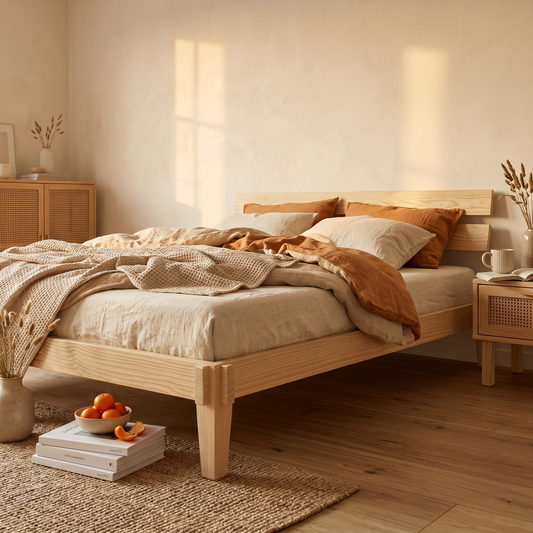
The Poka Bed by A Good Life establishes the bedroom's material language. Solid pinewood, screwless joinery, matte finish, low Japandi profile. Every other object in the bedroom is evaluated against this language. Linen textiles in warm white belong. A synthetic duvet cover in a cool grey does not. A warm lamp in a natural material belongs. A chrome bedside lamp does not.
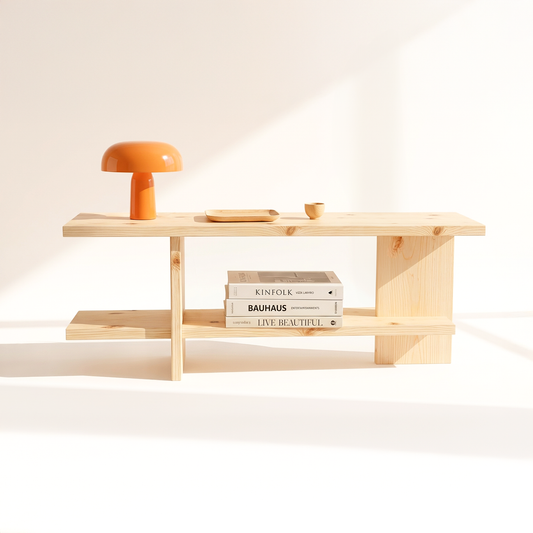
The Nagomi Pinewood Console establishes the entryway's material language. The same solid pinewood, the same matte finish, the same design philosophy. A plant in a terracotta pot belongs on its surface. A plastic key holder does not. A warm lamp belongs beside it. A fluorescent strip light does not.
The Akari Pinewood Mirror carries the language between the two spaces. In the entryway, it leans behind the Nagomi Console and reflects the home's first impression. In the bedroom, it leans beside the Poka Bed and reflects the room's depth and morning light. The same piece, the same material, two spaces connected by a single design decision.
What Happens When the Language Is Consistent
When the material language is consistent across the home, something shifts in the quality of the space. The home stops feeling like a collection of objects and starts feeling like a place. The transitions between rooms feel coherent rather than jarring. The objects in each room feel like they belong rather than like they were placed there.
This quality is what people mean when they say a home feels like the person who lives in it. It is not a reflection of personality in the decorative sense — the colours chosen, the art on the walls. It is a reflection of intention in the material sense — the consistency of the choices, the coherence of the framework, the sense that every object was chosen rather than accumulated.
The Home That Feels Like You
A home that feels like you is not a home that displays your personality. It is a home that reflects your values. If you value natural materials, honest craft and objects built to last, the home that reflects these values is furnished with solid wood, breathable finishes and traditional joinery. The Poka Bed, the Akari Mirror and the Nagomi Console are three pieces that embody these values in solid pinewood.
They are not a complete home. They are a framework. The bed anchors the bedroom. The console anchors the entryway. The mirror connects them. Everything else — the textiles, the lighting, the rug, the smaller objects — is chosen in relation to this framework. The home builds itself around the values expressed in three pieces of solid pinewood. The result is a home that feels like nobody else. It feels like you.