The most famous room of mirrors in the world is the Hall of Mirrors at Versailles. Seventeen arched mirrors facing seventeen arched windows, each mirror reflecting the gardens beyond the opposite windows, creating a room that feels infinite despite being a finite space. Louis XIV understood something about mirrors that most modern homeowners do not: a mirror does not just reflect a room. It creates one.
The principles that made Versailles's Hall of Mirrors one of the most spatially impressive rooms ever built are the same principles that make a full length floor mirror in a bedroom one of the most effective spatial interventions available. The scale is different. The logic is identical.
The Versailles Principle: Reflect What You Want to Multiply
The Hall of Mirrors works because the mirrors face windows, not walls. Each mirror reflects the gardens, the sky and the natural light from the opposite windows. The room appears to extend outward into the gardens on both sides simultaneously, which creates a sense of infinite space in a room that is, in fact, a long corridor.
The principle is simple: a mirror reflects whatever is opposite it. If you want to multiply space, reflect space. If you want to multiply light, reflect light. If you want to multiply a view, reflect the view. The mirror does not create anything. It doubles what you point it at.
In a bedroom, this principle translates directly. A full length mirror positioned opposite or adjacent to a window reflects the window, the sky and the natural light. The room appears to have two windows. The space appears to extend beyond the mirror. The light appears to come from two directions. The effect is not as dramatic as Versailles, but it operates on exactly the same logic.
Indian Palace Design and the Mirror Tradition
The use of mirrors to create spatial grandeur is not exclusively a European tradition. Indian palace architecture has its own mirror tradition, most famously in the Sheesh Mahal — the Palace of Mirrors — found in Amber Fort, Lahore Fort and several Rajput palaces. These rooms used thousands of small convex mirrors embedded in the ceiling and walls to create a room that appeared to be filled with stars when lit by a single candle.
The Sheesh Mahal tradition used mirrors differently from Versailles — not to reflect external space but to multiply internal light. The effect was not spatial expansion but luminous intensity: a small room that felt filled with light from every direction simultaneously. The principle is the same as Versailles but applied to light rather than space.
Both traditions understood that mirrors are not decorative objects. They are spatial tools. The decoration is a consequence of the spatial effect, not the purpose of it.
Applying Palace Logic to a Modern Bedroom
You do not need seventeen arched mirrors or a thousand embedded glass pieces to apply these principles to a bedroom. You need one well-chosen full length mirror in the right position.
Position a full length floor mirror opposite or adjacent to your bedroom window. The mirror reflects the window, the sky and the natural light. The room appears to have a second window. The space appears to extend beyond the mirror. The light appears to come from two directions. This is the Versailles principle applied to a single mirror in a single bedroom.
If your bedroom has a view worth reflecting — a garden, a courtyard, trees — position the mirror to reflect it. The view appears to exist on both sides of the room simultaneously. The bedroom feels connected to the outside in a way that a room without a mirror does not.
The Frame as Architecture
In palace design, the mirror frame is architectural. At Versailles, the frames are gilded and ornate, consistent with the baroque architecture of the room. In a Sheesh Mahal, the frames are the plasterwork that holds the mirror pieces, consistent with the Mughal decorative tradition.
In a contemporary bedroom, the frame should be consistent with the material language of the room. A wooden frame mirror in solid pinewood is the architectural frame for a bedroom built around natural materials. It is not ornate. It is not gilded. It is honest to its material and consistent with the other solid wood pieces in the room.
The Akari Pinewood Mirror is a full length floor mirror in solid pinewood with a frame proportioned for a contemporary bedroom. The matte finish is the contemporary equivalent of the palace frame — not decorative for its own sake but consistent with the material language of the space. Positioned to reflect a window or a view, it applies the Versailles principle to a bedroom with the same spatial logic and a fraction of the complexity.
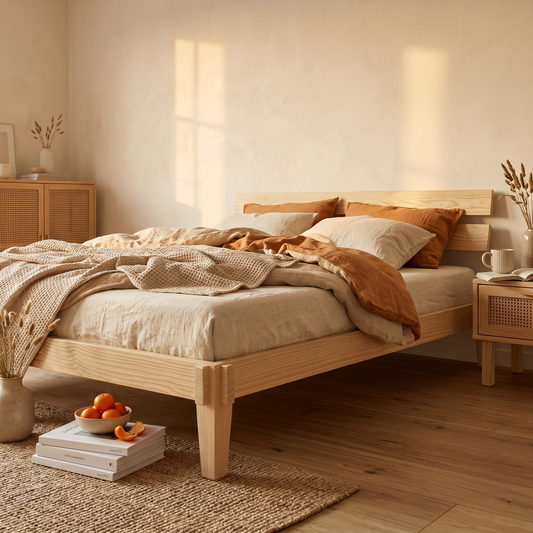
Paired with the Poka Bed in solid pinewood, the Akari Mirror creates a bedroom where the spatial quality is genuinely considered. The bed anchors the horizontal. The mirror extends the vertical and the depth. The room feels larger, lighter and more resolved than its dimensions suggest. This is what palace designers understood and what most modern bedrooms miss.
The Grand Room Is Not About Size
The Hall of Mirrors is grand not because it is large but because it is spatially intelligent. The Sheesh Mahal is grand not because it is opulent but because it understands light. Grandeur in a room is not a function of budget or square footage. It is a function of how well the space uses what it has.
A bedroom with a well-placed full length mirror, a solid wooden bed and natural light is applying the same spatial intelligence that built the most impressive rooms in history. The scale is domestic. The principle is timeless.