Sustainability in furniture is a conversation that usually focuses on the wrong things. Recycled packaging. Carbon-neutral shipping. FSC certification labels. These are not unimportant, but they are peripheral to the most significant environmental variable in furniture: how long it lasts. A piece of furniture that lasts twenty years has a fraction of the environmental footprint of a piece that lasts five, regardless of how it was shipped or what the packaging was made from.
Here is the honest environmental case for solid wood furniture and why a solid wooden bed is one of the most sustainable bedroom decisions you can make.
The Hidden Cost of Cheap Furniture
The global furniture industry produces an enormous volume of waste. In the UK alone, an estimated 22 million pieces of furniture are discarded every year. India's numbers are harder to track but the trajectory is similar as flat-pack and engineered wood furniture has become the default for urban households.
The environmental cost of this waste is not just the material going to landfill. It is the energy, water and raw materials consumed in manufacturing the replacement. Every time a cheap bed frame is replaced, the entire manufacturing cycle — raw material extraction, processing, manufacturing, finishing, packaging, shipping — happens again. The cumulative environmental cost of three cheap beds over fifteen years is significantly higher than the cost of one solid wooden bed that lasts the same period.
What Engineered Wood Actually Contains
MDF and particleboard are made from wood fibres, which sounds sustainable. What is less often discussed is the adhesive that binds those fibres. Most engineered wood uses urea-formaldehyde or similar resins, which off-gas volatile organic compounds into the room for months or years after manufacture. This is the chemical smell of new flat-pack furniture. It is not harmless.
Formaldehyde is classified as a known human carcinogen by the International Agency for Research on Cancer. The concentrations off-gassed by furniture are generally below acute harm thresholds, but in a bedroom where you spend eight hours a night, cumulative exposure over years is a legitimate consideration. Solid wood does not off-gas in this way. A solid hardwood bed finished with a natural oil or wax emits nothing into the room beyond the mild, pleasant scent of the wood itself.
Solid Wood as Carbon Storage
Trees absorb carbon dioxide during growth and store it as carbon in their wood. When a tree is harvested and made into furniture, that carbon remains stored in the wood for the life of the furniture. A solid wooden bed that lasts twenty years stores the carbon absorbed during the tree's growth for twenty years. A piece of engineered wood furniture that is sent to landfill after five years releases that carbon as the material decomposes.
This is not a complete accounting of the environmental impact of wood furniture — manufacturing, finishing and transport all have their own footprints — but it is a meaningful part of the picture that is rarely included in sustainability conversations about furniture.
Pinewood and Responsible Sourcing
Pinewood is one of the most responsibly sourced timber species available. Pine grows relatively quickly compared to hardwoods like teak or oak, which means responsibly managed pine forests can be harvested on a cycle that maintains forest cover. Pine plantations are also common in regions where they do not displace native forest, which reduces the biodiversity impact of harvesting.
When you buy a solid wooden bed in pinewood from a brand that is transparent about its sourcing, you are making a materially different environmental choice from buying an engineered wood frame made from unspecified wood fibres and petrochemical adhesives.
The Poka Bed: Built to Last, Not to Be Replaced
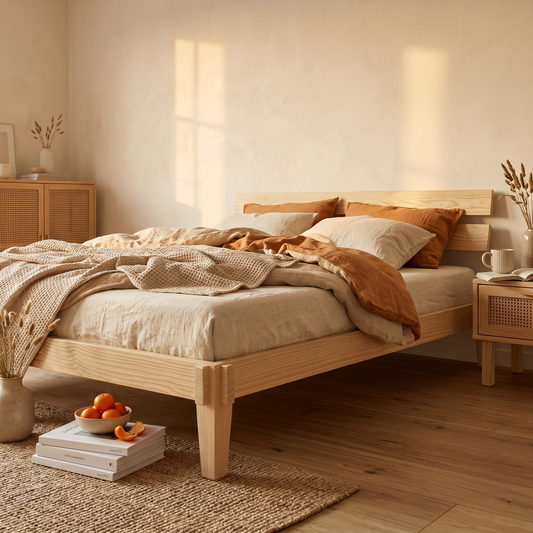
The Poka Bed by A Good Life is made from solid pinewood with screwless joinery and a matte oil finish. The screwless joinery means there are no metal fasteners to corrode or loosen. The matte oil finish is breathable and renewable — it can be refreshed with a light re-oiling rather than requiring stripping and refinishing. The solid pinewood construction means the frame does not contain the adhesives and resins that make engineered wood furniture a source of indoor air pollution.
A bed built this way is not a sustainable choice because it has a certification label. It is a sustainable choice because it is built to last twenty years rather than five. The most sustainable piece of furniture is the one you never have to replace.
The Mirror That Follows the Same Logic
A wooden frame mirror in solid pinewood follows the same environmental logic as a solid wooden bed. It does not contain MDF or particleboard. It does not off-gas adhesive resins. It does not need replacing every few years as the frame degrades. The Akari Pinewood Mirror is a full length floor mirror built from the same solid pinewood as the Poka Bed. It is designed to last, which is the only sustainability claim that actually matters.
Buying Less, Buying Better
The most sustainable approach to furnishing a bedroom is not to buy the most certified product. It is to buy fewer, better things that do not need replacing. A solid wooden bed and a solid pinewood mirror, chosen carefully and maintained simply, represent a lower environmental footprint over fifteen years than any number of cheaper alternatives replaced on a five-year cycle.
Sustainability in furniture is not complicated. It is just rarely framed honestly. Buy solid wood. Buy it once. Take care of it. That is the whole argument.