Most people assess their bedroom by how it looks in photographs or how it compares to a reference image they have saved somewhere. This is the wrong test. A bedroom is not a photograph. It is an environment you inhabit for roughly eight hours every night and several more during the day. The right test is not visual. It is experiential. Here is how to know whether your bedroom is actually working — and what to change if it is not.
The Entry Test
Walk out of your bedroom, close the door and wait thirty seconds. Then open the door and walk in as if for the first time. What do you feel in the first three seconds? Not what do you think — what do you feel. The first three seconds of entering a room are the most honest assessment available because they happen before the analytical mind has time to rationalise what it is seeing.
If the feeling is calm, settled or welcoming, the bedroom is working. If the feeling is cluttered, unsettled or neutral in a flat way, something is wrong. The feeling is not subjective in the way that taste is subjective. It is a response to objective properties of the room: the visual complexity, the proportions, the material quality, the light. These can be identified and changed.
The Full Mirror Test
Stand in front of your full length mirror — or, if you do not have one, imagine standing in front of one — and look at the room reflected behind you. The reflection shows you the room from a perspective you do not normally occupy. It shows you what the room looks like from the outside, which is closer to how it reads to a visitor or to your own subconscious when you enter it.
What does the reflected room tell you? Is it visually calm or visually busy? Does the bed look settled or does it look like the largest object in a room that has not been designed around it? Is the palette coherent or is it a collection of colours that happened rather than were chosen? Is there a vertical element — the mirror itself, a tall plant, a lamp — that draws the eye upward and makes the ceiling feel higher?
The full length mirror is both the tool for this test and one of the primary elements being assessed. A full length floor mirror in solid pinewood, positioned correctly, should appear in its own reflection as a warm vertical anchor that adds depth to the room rather than duplicating it. If it appears as a flat surface reflecting a wall, it is in the wrong position.
The Proportion Test
Look at the bed in relation to the room. Is it the right size for the space? A bed that is too small leaves dead space around it that makes the room feel unresolved. A bed that is too large crowds the room and raises the visual centre of gravity. The correct size bed for a room is the one that leaves adequate clearance on all sides — roughly 60 cm on each side and 90 cm at the foot — while filling the space with enough presence to anchor it.
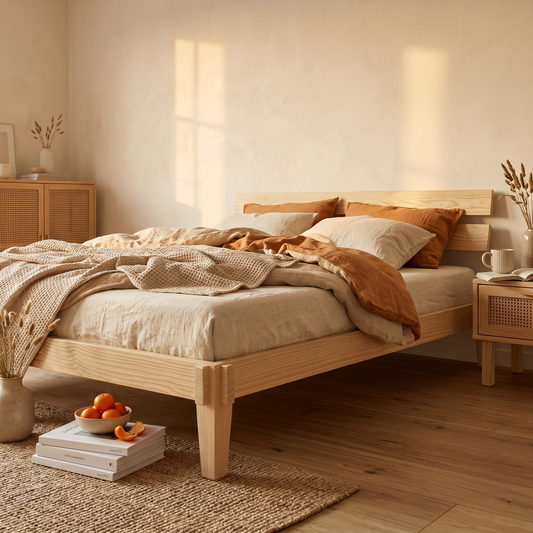
A king size bed frame in a room that can accommodate it proportionally is almost always the right choice for two adults. The Poka Bed by A Good Life in king size brings solid pinewood construction and screwless joinery to the larger format. The low Japandi silhouette means the bed reads as wide and grounded rather than wide and heavy, which is the proportional quality that makes a large bedroom feel resolved rather than crowded.
The Material Test
Walk around the room and touch the surfaces. Are the materials honest? Solid wood feels different from veneered MDF. Linen feels different from polyester. Natural materials have a tactile quality that synthetic ones do not, and this quality contributes to the feeling of the room in ways that are not visible but are consistently felt.
A bedroom that passes the material test has surfaces that feel as good as they look. The solid wooden bed frame is smooth and warm to the touch. The linen duvet cover is cool and slightly textured. The solid pinewood mirror frame is solid and matte rather than hollow and shiny. These tactile qualities are not luxuries. They are the difference between a room that feels like a retreat and one that feels like a set.
The Light Test
Assess the bedroom at three different times: morning natural light, afternoon natural light and evening artificial light. A bedroom that works in all three conditions is a bedroom that has been designed rather than decorated. Most bedrooms work in one condition and fail in the others.
Morning natural light should be warm and directional. A full length mirror adjacent to the window amplifies this. Afternoon light should be manageable — curtains or blinds that diffuse rather than block. Evening artificial light should be warm and layered, not overhead and cool. If any of these three conditions produces a room that feels wrong, the light is the problem and the solution is usually simpler than it appears.
The Subtraction Test
Remove everything from the bedroom that is not the bed, the mirror and the essential textiles. Look at the room. Does it feel better or worse? If it feels better, the objects you removed were adding visual noise rather than value. Return only the ones that genuinely improve the room. Leave the rest out.
This is the most revealing test of all. A bedroom that feels better empty than furnished is a bedroom that has been accumulated rather than designed. The solution is not more furniture or better furniture. It is less furniture, chosen more carefully.
The Bedroom That Passes Every Test
A bedroom built around a solid wooden bed, a full length floor mirror in solid pinewood, natural textiles and warm layered lighting passes all five tests consistently. The entry feeling is calm. The mirror reflection shows a room with depth and proportion. The bed is correctly scaled to the space. The materials are honest to the touch. The light works in all three conditions. And the subtraction test reveals that nothing in the room is there without earning its place.
The Akari Pinewood Mirror and the Poka Bed are the two pieces that anchor this bedroom. Same wood, same finish, same intention. A room built to be lived in rather than photographed. A bedroom that works.