
Mirrors are supposed to make rooms feel larger. That is the received wisdom. But walk into enough homes and you will find mirrors doing the opposite — cutting the room in half visually, bouncing light in the wrong direction or creating a sense of unease that nobody can quite explain. The mirror is not the problem. The placement is.
Here is what actually determines whether a mirror expands a room or shrinks it.
The Physics of Mirror Placement
A mirror reflects whatever is directly opposite it. That sounds obvious, but most people do not think through the implication when they hang or lean a mirror. If a mirror faces a wall, it reflects the wall and makes the room feel like it has a duplicate wall. If it faces a window, it reflects light and sky and makes the room feel like it has a second window. If it faces a cluttered corner, it doubles the clutter.
The single most effective mirror placement in any room is opposite or adjacent to a natural light source. A full length mirror positioned to catch daylight from a window will visually double the brightness of the room and create a sense of depth that no artificial lighting can replicate.
Full Length Mirror vs Wall Mirror — Which Works Better?
A full length wall mirror mounted at eye level solves the practical problem of seeing your full reflection but does little for the room proportionally. It reads as a flat surface rather than a window into space.
A full length floor mirror or standing mirror that reaches from near the floor to near the ceiling does something different. It creates a vertical line that draws the eye upward, making the ceiling feel higher. In a room with a 9 or 10-foot ceiling, a tall leaning floor mirror can make the space feel genuinely lofty rather than just adequate.
The leaning angle matters too. A floor mirror leaned at a slight angle reflects the ceiling and upper walls rather than the opposite wall directly, which creates a sense of openness rather than duplication. This is why a leaning floor mirror almost always looks better in a bedroom than a flat-mounted one at the same size.
The Bedroom Mirror: Placement Rules That Actually Work
For a standing mirror for bedroom use, these placements consistently work well:
- Beside the window, facing into the room — catches natural light and reflects the room's depth rather than its walls.
- In a corner at 45 degrees — reflects two walls simultaneously, creating a sense of infinite depth that is subtle but effective.
- Beside the wardrobe, not opposite the bed — practical for dressing without creating the sleep disruption that comes from a mirror directly facing the bed.
The one placement to avoid in a bedroom is directly opposite the bed. Beyond the feng shui concerns, the practical issue is light reflection. Any mirror opposite a window will catch morning light and direct it toward the bed, which disrupts sleep. Any mirror opposite a streetlight does the same at night.
Why the Frame Changes Everything
A mirror is not just glass. The frame determines how the mirror reads in the room. A heavy ornate frame makes a mirror feel like a statement piece, which works in some rooms and fights with others. A frameless mirror reads as modern but can feel cold. A wooden frame mirror in natural pinewood reads as warm, grounded and material-honest — which is why it works in almost any bedroom aesthetic from Japandi to contemporary to traditional.
The Akari Pinewood Mirror is a full length floor mirror with a solid pinewood frame and a matte finish. It is designed to lean, which gives you the placement flexibility that a wall-mounted mirror does not. The frame is proportioned to be present without being dominant — you notice the reflection before you notice the frame, which is exactly what a good mirror should do.
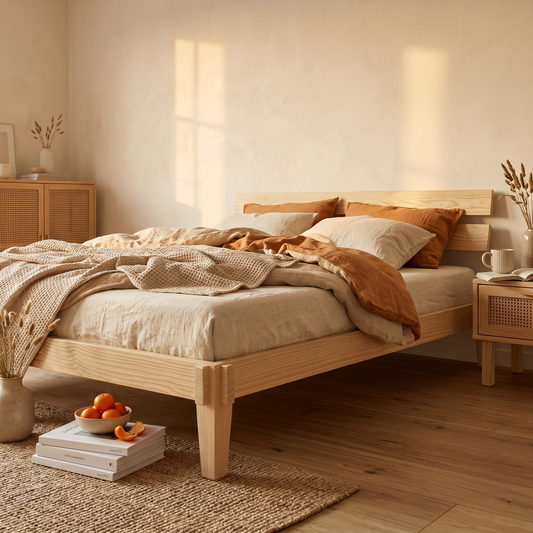
In a bedroom with a solid wood bed, the Akari's pinewood frame creates material continuity that makes the room feel considered rather than assembled. Pair it with the Poka Bed and the two pieces speak the same material language without matching in a way that feels contrived.
Long Mirror vs Full Size Mirror — Does Height Matter?
A long mirror that reaches from hip height to above the head gives you a functional reflection but does not do much for the room. A full size mirror or full length mirror that starts close to the floor and reaches near the ceiling does both — it gives you a complete reflection and it works architecturally in the space.
For most Indian bedrooms, a mirror between 150 cm and 180 cm tall hits the right balance. Tall enough to reflect the full body and create vertical presence. Not so tall that it overwhelms a room with standard ceiling heights.
Floor Mirror, Wall Mirror or Standing Mirror — Which Should You Buy?
The answer depends on how permanent you want the installation to be and how much flexibility you want to retain.
A floor standing mirror or leaning floor mirror requires no wall fixings, can be repositioned easily and works in rented homes where drilling is restricted. A full length wall mirror is more permanent but frees up floor space. A standing mirror for bedroom use with a base stand gives you stability without wall fixings but takes up more floor area than a leaning mirror.
For most bedrooms, a leaning full length floor mirror is the most versatile choice. It is the easiest to live with, the easiest to move and, when the frame is right, the most visually interesting of the three options.
The Room You See Every Morning
Your bedroom mirror is the first thing you look into every morning. It sets the tone for how you see yourself before you leave the house. Getting the placement right is not a design exercise. It is a daily quality-of-life decision. A full length mirror in the right position, with the right frame, in the right room, is one of those small changes that turns out to matter more than you expected.