A full length mirror is one of the most useful objects in a bedroom. It is also one of the most frequently bought badly. The wrong size, the wrong frame, the wrong glass quality or the wrong placement can turn a practical purchase into a daily source of minor frustration. Here is everything that actually matters when choosing a full length mirror for your bedroom.
Size: How Tall Does a Full Length Mirror Actually Need to Be?
A true full length mirror should show your complete reflection from head to foot when standing at a normal viewing distance. The physics of reflection mean that a mirror only needs to be half your height to show your full body, but this assumes you are standing directly in front of it at a specific distance. In practice, a mirror between 150 cm and 180 cm tall gives you a complete reflection at a comfortable viewing distance and works proportionally in most Indian bedrooms.
A full size mirror shorter than 150 cm will cut off your feet or your head depending on how it is mounted or positioned. A mirror taller than 180 cm starts to dominate a room with standard ceiling heights. The 150 to 180 cm range is the practical sweet spot for most bedrooms.
Floor Mirror vs Wall Mirror: Which Is Right for Your Space?
A full length wall mirror is fixed, space-efficient and stable. It works well in a bedroom where you know exactly where you want the mirror and are confident you will not want to move it. The limitation is permanence — once mounted, repositioning requires filling holes and repainting.
A full length floor mirror or leaning floor mirror requires no wall fixings, can be repositioned freely and works in rented homes where drilling is restricted. The limitation is that it takes up a small amount of floor space and needs a wall to lean against. For most bedrooms, the flexibility of a leaning mirror outweighs the space consideration.
A floor standing mirror with a base stand is a third option that offers stability without wall fixings but takes up more floor area than a leaning mirror. It works well in larger rooms where the base does not create a tripping hazard.
Frame Material: Why It Matters More Than You Think
The frame of a full length mirror does three things: it protects the edges of the glass, it provides structural rigidity and it contributes to the visual character of the room. The material determines how well it does all three.
A wooden frame mirror in solid pinewood is warm, structurally rigid and visually neutral enough to work in almost any bedroom aesthetic. It does not conduct temperature the way metal frames do, which means it does not feel cold to the touch in an air-conditioned room. It does not yellow or corrode the way cheaper metal frames can. And it ages gracefully — a solid pinewood frame develops a patina over time rather than degrading.
MDF or particleboard frames are common in budget mirrors. They are heavier than solid wood for the same visual size, less moisture-resistant and prone to corner separation over time, particularly in a leaning configuration where the frame bears its own weight at an angle.
The Akari Pinewood Mirror uses a solid pinewood frame with a matte finish. It is designed as a leaning floor mirror with frame proportions that are present without being dominant. The frame is wide enough to provide structural rigidity and visual warmth but not so wide that it competes with the reflection. In a bedroom with a solid wood bed, the material continuity between the two pieces creates a room that feels considered rather than assembled.
Glass Quality: The Variable Nobody Mentions
Not all mirror glass is the same. Standard mirror glass has a slight green tint that is most visible at the edges and in large reflections. This tint comes from the iron content of the glass and is more pronounced in thicker glass. Low-iron glass, sometimes called crystal-clear glass, has a significantly lower iron content and gives a truer, warmer reflection.
In a small mirror, the difference is barely noticeable. In a full length mirror that you look into every morning, it is. A mirror with standard glass gives a slightly cooler, greener reflection. A mirror with low-iron glass gives a warmer, more accurate one. If you are choosing between two mirrors at similar price points, glass quality is worth asking about.
Long Mirror for Bedroom: Placement That Actually Works
A long mirror for bedroom use works best when it is positioned to reflect light rather than walls. The most effective placements are adjacent to a window, where the mirror catches natural light and reflects it into the room, or in a corner at a slight angle, where it reflects two walls simultaneously and creates a sense of depth.
The placement to avoid is directly opposite the bed. A mirror facing the bed reflects movement and light during the night, which can disrupt sleep. It also creates a slightly unsettling visual experience of seeing yourself in the dark when you wake in the night — a minor thing that becomes less minor over time.
For a standing mirror for bedroom use, the adjacent-to-window placement is almost always the best starting point. Position it, live with it for a few days and adjust if needed. The advantage of a leaning floor mirror is that this iteration is easy.
Pairing the Mirror With the Bed
A full length mirror and a solid wooden bed are the two most visually significant pieces in most bedrooms. When they share a material language — the same wood species, the same finish type, the same aesthetic register — the room feels coherent. When they do not, the room feels assembled from separate decisions.
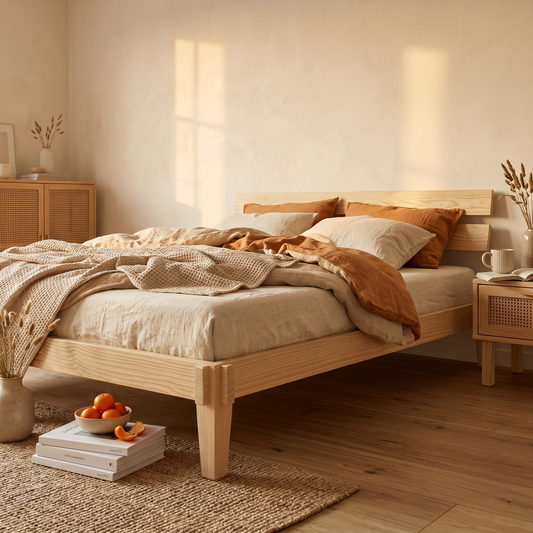
The Poka Bed and the Akari Pinewood Mirror are both made from solid pinewood with a matte finish. They are not a matched set in the sense of being identical — the bed is a structural piece and the mirror is a reflective one — but they speak the same material language. In a bedroom, this is the difference between furniture that looks like it belongs together and furniture that looks like it was bought at different times from different places.
The Mirror You Will Use Every Day
A full length mirror is not a decorative object. It is a functional one that you interact with every single day. The quality of that interaction — the accuracy of the reflection, the warmth of the frame, the stability of the lean — matters more than any single purchase decision in the bedroom. Choose it with the same care you would give to the bed itself.