The choice between a floor mirror and a wall mirror seems like a practical one. Where does the mirror go? Is there wall space? Is there floor space? But the decision has implications beyond logistics — for the visual quality of the room, the flexibility of the layout and the long-term relationship you have with the mirror as a daily object. Here is a complete comparison.
What a Floor Mirror Actually Is
A floor mirror is any full length mirror that rests on the floor rather than being mounted to a wall. This includes leaning floor mirrors, which lean against a wall without fixings, and floor standing mirrors, which have a base frame or stand that holds them upright independently. The defining characteristic is that the mirror is not attached to the wall.
A full length floor mirror is typically taller than a wall-mounted mirror because it needs to provide a complete reflection from floor level upward. The most common height range is 150 to 180 cm, which gives a complete full-body reflection for most adults at a comfortable viewing distance.
What a Wall Mirror Actually Is
A full length wall mirror is mounted directly to the wall, either with brackets, mirror clips or adhesive. It takes up no floor space and is completely stable once mounted. The limitation is permanence — once mounted, repositioning requires removing the fixings, filling the holes and repainting if necessary.
A full length wall mirror can be mounted at any height, which gives some flexibility in how much of the reflection is visible. Mounted with the bottom edge at floor level, it gives the same reflection as a floor mirror. Mounted higher, it shows less of the lower body.
The Case for a Leaning Floor Mirror
A leaning floor mirror has three advantages that a wall mirror cannot match: flexibility, installation simplicity and visual character.
Flexibility is the most practical advantage. A leaning mirror can be repositioned in seconds. If you discover that the current position is catching unwanted light at night, you move it. If you redecorate and the mirror no longer works in its current position, you move it. If you move home, you take it with you without leaving holes in the wall. For renters, this is not a minor consideration. For owners, it is still a meaningful one.
Installation simplicity means no drilling, no wall anchors, no risk of hitting a pipe or cable and no damage to the wall. A leaning floor mirror is placed and done. A wall mirror requires tools, precision and a degree of commitment to the position that a leaning mirror does not.
Visual character is the most subjective advantage but often the most significant. A leaning mirror has a relaxed, considered quality that a wall-mounted mirror does not. It reads as intentional rather than installed. In a bedroom designed around natural materials and visual calm, a leaning full length mirror in solid pinewood feels like it belongs in a way that a wall-mounted mirror with brackets does not.
The Case for a Wall Mirror
A wall mirror has two genuine advantages: stability and floor space. A mounted mirror cannot be knocked over, which matters in homes with children or pets. And a wall mirror takes up zero floor space, which matters in very small bedrooms where every square centimetre of floor is needed.
For a bedroom under 100 square feet, a wall-mounted full length mirror may be the more practical choice simply because a leaning mirror's footprint — small as it is — is space that cannot be used for anything else. For larger bedrooms, this consideration is largely irrelevant.
The Akari Pinewood Mirror: Built for Leaning
The Akari Pinewood Mirror is a full length floor mirror in solid pinewood designed specifically for leaning. The solid pinewood frame provides the weight and structural rigidity to hold the mirror safely in position without wall fixings. The frame proportions are calculated for the leaning angle — wide enough to be stable, slim enough to be visually quiet.
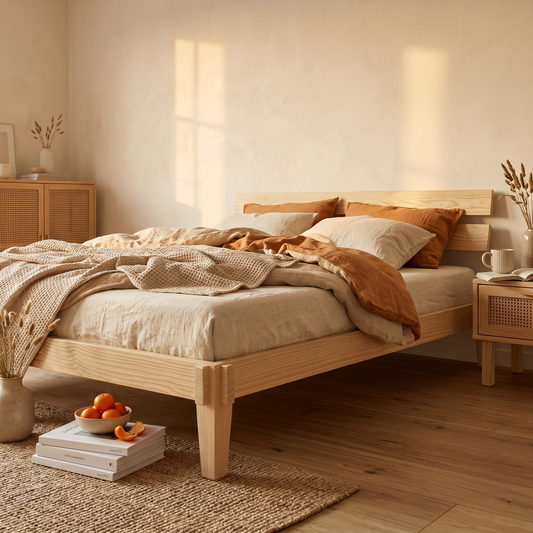
The matte finish on the solid pinewood frame means the mirror reads as warm and natural in the room rather than as a functional object that has been placed somewhere. In a bedroom with the Poka Bed, the Akari Mirror's solid pinewood frame creates material continuity that makes the room feel considered. The two pieces share the same wood, the same finish and the same design philosophy: honest materials, clean lines, nothing unnecessary.
The Practical Decision Framework
Choose a leaning floor mirror if you rent, if you value flexibility, if your bedroom is large enough to accommodate the footprint or if you want the visual character of a leaning mirror in a room designed around natural materials.
Choose a wall mirror if you have children or pets who might knock a leaning mirror, if your bedroom is very small and floor space is genuinely at a premium or if you need the mirror in a specific position that a leaning mirror cannot achieve safely.
For most bedrooms and most people, the leaning floor mirror is the better choice. It is more flexible, easier to install, more visually interesting and, when the frame is solid pinewood, more materially honest than a wall-mounted alternative. The floor mirror has been the right answer for most bedrooms for a long time. It still is.