The idea that a mirror can change your mood sounds like the kind of claim that belongs in a wellness magazine rather than a design guide. But the relationship between mirrors, light, space and psychological state is more grounded in research than the wellness framing suggests. Here is what colour psychology, environmental psychology and reflection science actually say about what a full length mirror does to the person in the room with it.
The Self-Perception Loop
Research in social psychology has consistently found that seeing your own reflection activates self-awareness in ways that affect behaviour and mood. A mirror in a room makes people more conscious of themselves, which can be positive or negative depending on the context and the quality of the reflection.
In a bedroom context, a full length mirror that gives a warm, accurate reflection in good light activates a positive self-perception loop. You see yourself clearly, in flattering light, in a room that feels considered. The self-awareness this produces is associated with confidence and calm rather than anxiety. A mirror that gives a distorted, greenish reflection in poor light produces the opposite effect — a self-perception that is subtly negative and a mood that reflects it.
This is not a dramatic effect. It does not transform your morning. But it is consistent, and consistency over months produces a meaningful difference in baseline self-perception and morning mood.
Light Quality and Emotional State
The light that a mirror reflects is as important as the reflection itself. A full length mirror positioned to reflect natural morning light fills the room with warm, directional light that is associated with alertness and positive affect. A mirror positioned to reflect a cool white overhead light fills the room with the kind of light that is associated with clinical environments and mild stress.
The colour temperature of light has a well-documented effect on mood. Warm light at 2700K or lower is associated with relaxation and comfort. Cool light at 5000K or higher is associated with alertness and, in excess, with anxiety. A full length floor mirror that amplifies warm natural light is contributing to the emotional quality of the room in a way that is measurable even if it is not consciously noticed.
Space Perception and Psychological Safety
Environmental psychology research consistently finds that perceived space affects psychological state. Cramped environments elevate cortisol and activate mild stress responses. Spacious environments reduce cortisol and activate the parasympathetic nervous system. A full length mirror that makes a room feel larger is not just an aesthetic intervention. It is a psychological one.
A standing mirror for bedroom use positioned to reflect the room's depth makes the bedroom feel more spacious than it is. The brain responds to this perceived spaciousness with the same physiological calm it would produce in a genuinely larger room. The effect is not as strong as actual space, but it is real and it is consistent.
The Frame's Contribution to Mood
The frame of a full length mirror contributes to mood through the same mechanism as any other material in the room. Natural materials — solid wood, stone, linen — activate the parasympathetic nervous system through the biophilic response. Synthetic materials — plastic, metal, high-gloss lacquer — do not produce this response.
A wooden frame mirror in solid pinewood contributes to the natural material environment of the bedroom in a way that a plastic or metal-framed mirror does not. The frame is not just a border around the glass. It is a material presence in the room that either supports or undermines the psychological quality of the space.
The Akari Pinewood Mirror is a full length floor mirror in solid pinewood with a matte finish. The frame is warm, natural and tactilely honest — it feels like wood because it is wood. In a bedroom designed around natural materials, it contributes to the biophilic quality of the space rather than interrupting it. Positioned to catch morning light, it amplifies the warm natural light that supports positive mood and calm alertness.
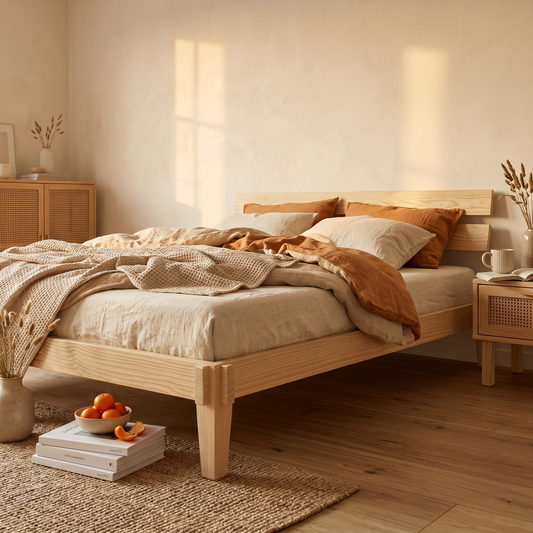
Paired with the Poka Bed — solid pinewood, screwless joinery, matte finish — the Akari Mirror completes a bedroom where every material is natural, every surface is honest and the psychological quality of the space is genuinely considered. This is not wellness marketing. It is environmental psychology applied to a bedroom.
The Practical Conclusion
A full length mirror in the right position, with the right frame, in the right light does three things for your mood: it gives you an accurate and flattering self-reflection, it amplifies warm natural light and it makes the room feel more spacious. None of these effects is dramatic in isolation. Together, experienced consistently every morning for months and years, they produce a meaningful difference in how you feel in the room and how you leave it.
The mirror is not a mood device. It is a well-designed object in a well-designed room. The mood follows from the design.