Most surfaces in a home are passive. They receive light and reflect it uniformly. A painted wall, a flat glass door, a polished countertop — all of these surfaces behave predictably with light. Fluted glass does something different. It refracts light, bending and scattering it in multiple directions simultaneously, creating a surface that is alive with movement and warmth in a way that no flat surface can replicate. This is why a fluted glass cabinet is the most visually interesting surface in almost any room it occupies.
The Physics of Fluted Glass and Light
When light hits a flat glass surface, it passes through or reflects off in a single, predictable direction. When light hits the ridged surface of fluted glass, each ridge acts as a small lens, bending the light at a slightly different angle from the ridges beside it. The result is a surface that scatters light in multiple directions simultaneously, creating a soft, diffused glow rather than a single reflection.
This effect is most pronounced when there is a light source behind the fluted glass — inside a cabinet with interior lighting, or a cabinet positioned to catch natural light from a window. In these conditions, fluted glass kitchen cabinet doors produce a warm, luminous effect that changes subtly as the light source moves through the day. The cabinet is different at 8am than it is at 4pm. It is different on a cloudy day than on a sunny one. It is alive in a way that a solid door or a clear glass door is not.
The Texture That Works With Every Palette
One of the practical advantages of fluted glass is its palette neutrality. The ribbed texture of fluted glass reads as warm and natural regardless of the colour of the frame or the contents behind it. A fluted glass cabinet in a white kitchen reads as soft and considered. The same cabinet in a warm wood kitchen reads as an extension of the wood's natural texture. In a Japandi home with a warm neutral palette, fluted glass belongs as naturally as solid wood and linen.
This palette neutrality makes fluted glass cabinet doors one of the most versatile design choices available. Unlike coloured glass or patterned glass, which commit the room to a specific aesthetic direction, fluted glass works with almost any direction the room takes. It is a material that enhances rather than dictates.
Fluted Glass in the Kitchen: The Practical Case
Beyond the aesthetic qualities, fluted glass kitchen cabinets have practical advantages that clear glass does not. The textured surface obscures the contents of the cabinet, which means the kitchen looks considered regardless of how the interior is organised. Everyday crockery, mismatched containers and half-used packets are all softened by the fluted glass into impressions of colour and shape rather than specific objects.
The texture also reduces the visibility of fingerprints and water marks on the glass surface. A clear glass cabinet door in a kitchen shows every touch. A fluted glass cabinet door in the same kitchen shows almost none. In a room that is used as intensively as a kitchen, this practical advantage is significant.
The Kanso Fluted Cabinet: Light Made Furniture
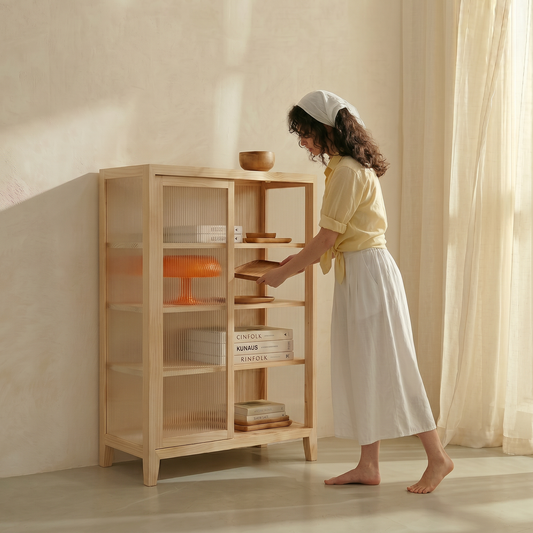
The Kanso Fluted Cabinet by A Good Life is built around the light-catching quality of fluted glass. The fluted glass cabinet doors are set in a solid pinewood frame that provides the warm, natural material context that makes the glass's light diffusion most effective. The matte finish on the pinewood frame absorbs light rather than reflecting it, which means the glass is the surface that catches the eye rather than the frame.
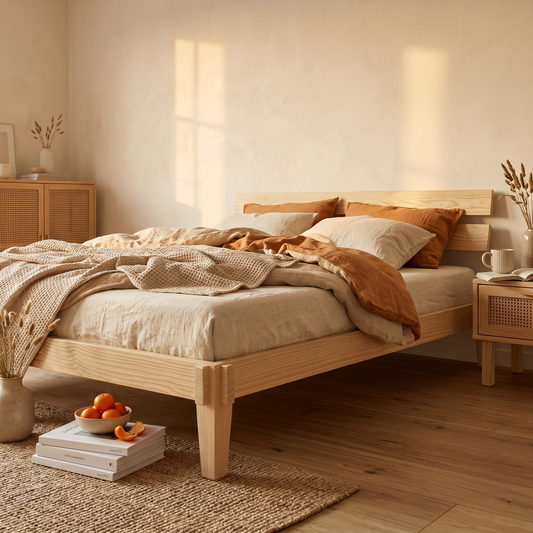
In a kitchen, the Kanso Cabinet positioned to catch natural light from a window produces the full light-refraction effect of fluted glass throughout the day. In a living room or bedroom, it provides storage with a visual presence that changes with the light. Alongside the Akari Pinewood Mirror, which reflects light, and the Poka Bed, which absorbs it, the Kanso Cabinet completes a room where every surface has a considered relationship with light.
The Surface Worth Looking At
A home full of passive surfaces — flat walls, clear glass, polished countertops — is a home that is visually complete but not visually interesting. A fluted glass cabinet introduces a surface that is genuinely worth looking at, one that changes with the light and rewards attention without demanding it. In a room designed around natural materials and visual calm, this is the quality that makes the difference between a room that is resolved and one that is alive.