There are bedrooms you sleep in and bedrooms you retreat to. The difference between them is not square footage or budget. It is intention. A bedroom that feels like a genuine retreat is the result of a series of decisions made in the right order, with the right criteria. This is the complete guide to making those decisions well.
The One Question That Changes Everything
Before any furniture is chosen, any colour is selected or any mirror is placed, ask yourself one question: what do I want to feel when I walk into this room at the end of the day? Not what do I want it to look like. What do I want it to feel like.
The answer to this question is your brief. Every decision that follows is evaluated against it. If the answer is calm and grounded, you are building a Japandi bedroom. If the answer is warm and enveloping, you are building something slightly different. Either way, the feeling comes first. The furniture serves the feeling, not the other way around.
The Bed: The Decision That Sets Everything Else
The bed is the largest object in the bedroom and the one that determines the proportional, material and aesthetic baseline for everything else. Get this decision right and the rest of the room becomes easier. Get it wrong and no amount of styling fixes it.
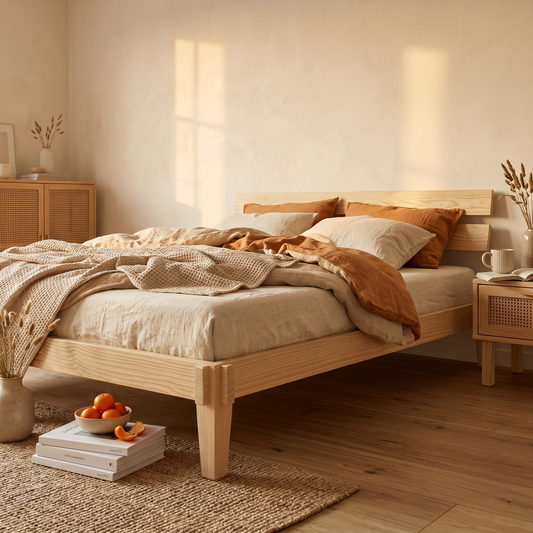
For a bedroom that feels like a retreat, the criteria for the bed frame are consistent across almost every aesthetic: solid wood, low profile, clean lines, matte finish, no visible hardware. These are not stylistic preferences. They are the properties that produce visual calm, acoustic softness and the sense of groundedness that makes a bedroom feel like a place to rest rather than a place to store a mattress.
A king size bed frame in a room that can accommodate it proportionally is almost always the right choice for two adults. The additional width is not a luxury. It is the difference between sleeping together and sleeping well together. A solid hardwood bed at king size, with correct slat spacing and screwless joinery, is the single highest-leverage bedroom investment available.
The Poka Bed by A Good Life is built for exactly this purpose. Solid pinewood, screwless joinery, a low Japandi silhouette and a matte finish that absorbs light rather than reflecting it. It is available in king size and designed for the Indian bedroom as it actually exists — with monsoon humidity, temperature variation and the expectation that furniture should last not five years but twenty. It is the bed you buy when you are done replacing beds.
The Palette: Let the Wood Lead
Once the bed frame is chosen, the palette follows from the wood. Solid pinewood is warm and light — a tone that sits between honey and cream and reads as neutral without being cold. The palette that works with it is drawn from the same natural spectrum: warm white, sand, stone, undyed linen, soft terracotta. These colours do not date because they are not trend colours. They are the colours of natural materials.
Keep the palette to three tones at most. A warm white for walls and ceiling. A mid-tone natural for textiles. The wood itself as the third tone. Everything else is a variation within this range rather than a departure from it.
The Textiles: Natural Materials Only
Textiles are the layer of the bedroom that you feel rather than see. Linen, cotton and wool breathe, soften with washing and age in the same direction as solid wood — better rather than worse. Synthetic textiles do not breathe, do not soften and do not age well. In a bedroom built around natural materials, synthetic textiles create a material inconsistency that undermines the feeling of the room even when it is not consciously noticed.
A linen duvet cover in warm white or natural undyed linen is the textile decision that does the most work. Add a cotton or wool throw in a stone or sand tone. Keep the pillow count honest — the pillows you actually sleep on, not a decorative arrangement that has to be moved every night.
The Mirror: Depth, Light and Proportion
A full length mirror is the most effective non-structural tool for improving a bedroom. Positioned correctly, it doubles the perceived depth of the room, amplifies natural light and provides a practical full-body reflection for daily use. Positioned incorrectly, it reflects walls, bounces unwanted light and creates visual duplication that makes the room feel smaller rather than larger.
The correct placement for a standing mirror for bedroom use is adjacent to the window, angled slightly to catch natural light and reflect the room's depth. Not opposite the bed, where it reflects movement and light during the night. Not facing a wall, where it reflects nothing useful. Adjacent to the light source, where it does everything a mirror should do.
The frame matters as much as the placement. A wooden frame mirror in solid pinewood reads as warm and natural. It does not compete with the bed for visual attention. It does not conduct temperature the way metal frames do. And it ages in the same direction as the solid wood bed it sits alongside.
The Akari Pinewood Mirror is a full length floor mirror in solid pinewood designed to lean. No wall fixings, no installation, no commitment to a position before you have found the right one. The frame is matte-finished to match the material language of the Poka Bed. In a bedroom where both pieces are present, the room feels complete in a way that is difficult to achieve when materials are mixed without intention. Two pieces, the same wood, the same finish, the same philosophy. A bedroom that is built rather than accumulated.
The Lighting: Warm, Layered and Low
Overhead lighting at full brightness is the enemy of a bedroom that feels like a retreat. Replace it with layered warm lighting at different heights: bedside lamps on each side of the bed, a floor lamp in a corner if the room is large enough and the overhead light reserved for practical tasks only. Warm bulbs at 2700K or lower. Dimmers if possible. The goal is a room that can be lit at different intensities for different purposes — bright enough to read, dim enough to wind down, dark enough to sleep.
The Edit: Remove Before You Add
The final step in creating a bedroom that feels like a retreat is not adding the last few objects. It is removing the ones that do not belong. Every object that creates visual noise, every surface that accumulates things without purpose, every piece of furniture that does not earn its place — remove it. The bedroom that feels like a retreat is not the one with the most carefully chosen objects. It is the one where nothing unnecessary remains.
This is the Japandi principle at its most practical. Not minimalism. Intentionality. Every object chosen. Nothing accumulated. A room that asks nothing of your attention so your attention can rest.
The Bedroom You Deserve
A bedroom that feels like a genuine retreat is not a luxury. It is a daily quality-of-life decision that compounds over time. You spend roughly a third of your life in this room. The materials in it, the objects in it and the way it is arranged affect how you sleep, how you wake and how you feel about the day ahead.
A solid wooden bed that lasts twenty years. A full length mirror that reflects the best light in the room. Natural textiles that breathe and soften. Warm layered lighting. A palette drawn from nature. Nothing that does not belong.
This is not a difficult room to build. It is a disciplined one. And the discipline, once applied, produces a room you will never want to leave.