There is a particular kind of tiredness that sleep does not fix. You go to bed exhausted, you sleep for seven or eight hours and you wake up still tired. The hours were there. The rest was not. If this is a pattern rather than an occasional occurrence, the problem is almost certainly the environment rather than the sleep itself. Your bedroom may be working against you.
The Bedroom Is Not a Neutral Space
Most people treat the bedroom as a passive container for sleep. It is not. Every element of the room — the light, the materials, the visual complexity, the temperature, the sounds it absorbs or reflects — actively affects the quality of the rest that happens in it. A bedroom that is well-designed for sleep does not just look calm. It produces calm, physiologically, in the person sleeping in it.
This is not a soft claim. Environmental psychology research is consistent on this point. The materials in a room affect cortisol levels. The visual complexity of a room affects how quickly the brain transitions from wakefulness to sleep. The acoustic properties of a room affect how deeply sleep is maintained. The bedroom is an active participant in your rest, not a backdrop to it.
Visual Noise and the Sleeping Brain
The brain does not fully switch off when you close your eyes. It continues to process environmental information, particularly visual information, during the transition to sleep. A room with high visual complexity — many objects, competing colours, reflective surfaces, visible clutter — keeps the brain's processing load elevated during this transition. The result is a longer time to fall asleep and lighter sleep in the early stages of the night.
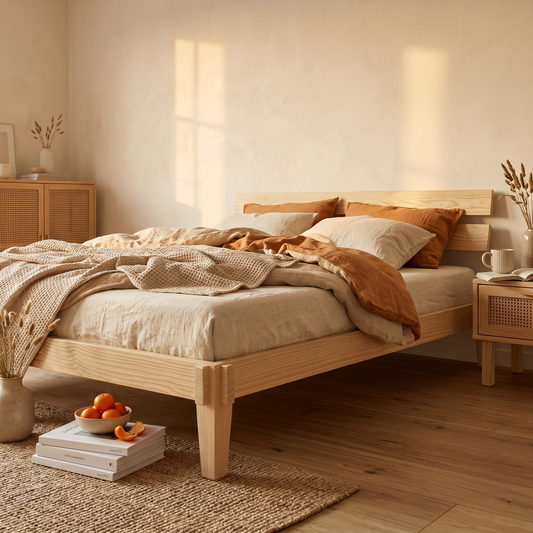
Reducing visual noise is one of the highest-leverage changes you can make to a bedroom. This does not mean emptying the room. It means choosing objects that are visually quiet. A solid wooden bed with clean lines and no visible hardware contributes almost no visual noise. A bed with ornate detailing, visible bolts and a high-gloss finish contributes significantly more, even when the room is otherwise tidy.
The Poka Bed by A Good Life is designed around visual quietness. The solid pinewood frame has no visible joinery hardware, no high-gloss surfaces and a low profile that keeps the visual centre of gravity close to the ground. In a bedroom, it reads as settled and calm — which is the quality you want the largest object in the room to project.
The Acoustic Bedroom
Sound is the most underrated element of bedroom design. Hard surfaces — tile, glass, metal, high-gloss lacquer — reflect sound and create a room that feels acoustically live. Soft surfaces — natural wood, linen, cotton, wool — absorb sound and create a room that feels acoustically soft.
A solid wooden bed frame absorbs sound rather than reflecting it. Natural textiles on the bed do the same. A wooden frame mirror with a solid pinewood frame contributes less acoustic reflection than a frameless glass mirror or a metal-framed one. These are small individual contributions that add up to a room that feels genuinely quiet rather than just quiet when there is no noise.
In an urban Indian home where external noise is a constant, the acoustic properties of bedroom materials are not a luxury consideration. They are a practical one.
Temperature and the Sleeping Environment
The ideal sleeping temperature for most adults is between 18 and 22 degrees Celsius. In Indian summers, achieving this requires air conditioning. But the material of your bed frame affects how the room feels at any given temperature.
Metal bed frames conduct heat and cold. In a room that is air-conditioned, a metal frame feels cold to the touch and can create a localised cold zone around the bed. In a room without air conditioning, it retains heat. Solid wood is a natural insulator. It does not conduct temperature the way metal does, which means it feels neutral to the touch regardless of the room temperature. A solid hardwood bed or solid wooden bedframe is simply more comfortable to be near in a range of temperature conditions.
Light and the Circadian Rhythm
Light is the primary regulator of the circadian rhythm — the internal clock that determines when you feel sleepy and when you feel alert. Morning light signals wakefulness. Evening light, particularly blue-spectrum light, suppresses melatonin and delays sleep onset.
A full length mirror or standing mirror for bedroom use positioned to catch morning light is a genuine sleep aid. It amplifies the morning light signal that tells your body it is time to be awake, which in turn makes the evening sleep signal stronger. A mirror that catches streetlight or artificial light at night does the opposite.
The Akari Pinewood Mirror is a leaning floor mirror that can be repositioned to optimise for morning light without being fixed in a position that catches unwanted light at night. The solid pinewood frame keeps the mirror visually warm rather than clinical, which matters in a room designed for rest.
The Bedroom That Does the Work
Rest is not something you achieve through willpower. It is something your environment either supports or undermines. A bedroom with natural materials, low visual complexity, acoustic softness and considered light management does not guarantee perfect sleep. But it removes the environmental obstacles that prevent it.
A solid wooden bed, natural textiles, a well-placed full length mirror and a palette drawn from nature are not design choices. They are sleep infrastructure. The bedroom that works hardest for your rest is the one that asks the least of your attention. Build it that way and the rest takes care of itself.