Every bedroom has at least one corner that does nothing. It collects the things that have no other home — a chair with clothes on it, a bag that was never unpacked, a lamp that was moved there temporarily three years ago. The corner is not a storage problem. It is a design opportunity that most people never take. A full length floor mirror in the right corner can transform the most neglected part of a bedroom into its most effective spatial element.
Why Corners Are Underused in Bedroom Design
Corners are structurally awkward. Furniture designed for flat walls does not fit neatly into corners. A wardrobe in a corner wastes the angled space behind it. A bedside table in a corner is too far from the bed to be useful. Most bedroom furniture is designed for walls, which leaves corners as residual space that accumulates objects rather than serving a purpose.
A leaning floor mirror is one of the few objects that actually works better in a corner than on a flat wall. Leaned into a corner at roughly 45 degrees, a full length mirror reflects two walls simultaneously rather than one. The result is a sense of depth that reads as a room extending in two directions rather than one, which is significantly more spatially expansive than a mirror on a flat wall reflecting a single surface.
The 45-Degree Reflection Effect
When a full length floor mirror is placed in a corner at 45 degrees, it reflects the two walls that form the corner. If those walls are light in colour and one of them has a window, the mirror reflects both the wall and the natural light from the window simultaneously. The brain reads this as a room that extends in two directions, which produces a perception of space that is greater than either a flat-wall mirror or an empty corner can achieve.
The 45-degree placement also means the mirror is unlikely to reflect the bed directly, which avoids the sleep disruption that comes from a mirror facing the sleeping position. The reflection is angled away from the bed, which gives you all the spatial benefits of a large mirror without the sleep costs of a poorly placed one.
What the Corner Mirror Does to Light
A mirror in a corner catches light from two directions rather than one. In a bedroom with windows on adjacent walls, a corner mirror reflects light from both sources simultaneously, which creates a brightness in the corner that makes the room feel more evenly lit. In a bedroom with a single window, a corner mirror adjacent to that window reflects the window light into the darkest part of the room — the opposite corner — which reduces the contrast between the bright and dark areas of the space.
This light distribution effect is particularly valuable in Indian bedrooms, which often have a single window on one wall and significantly darker areas on the opposite side of the room. A full length mirror in the corner adjacent to the window is one of the most effective ways to improve the light quality of the entire room without any structural change.
The Akari Pinewood Mirror in a Corner
The Akari Pinewood Mirror is a full length floor mirror in solid pinewood designed to lean. Its leaning format makes it ideal for corner placement — it can be angled precisely without wall fixings, adjusted until the reflection is exactly right and repositioned if the room changes. The solid pinewood frame provides the weight and structural rigidity to hold the mirror safely in a corner position without any attachment to the walls.
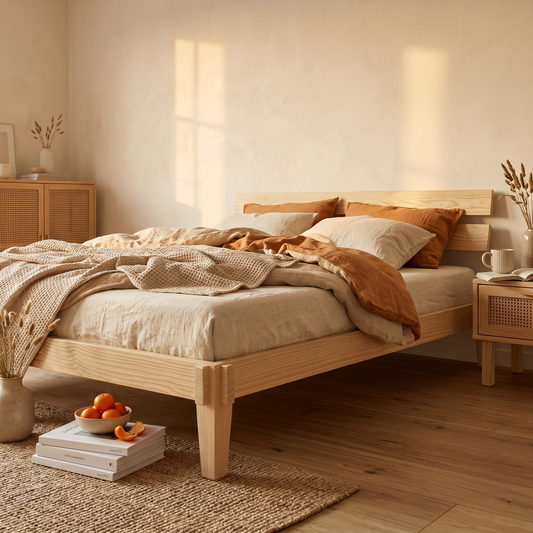
The matte finish on the solid pinewood frame means the frame reads as warm and natural in the corner rather than as a functional object that has been placed somewhere. In a bedroom with the Poka Bed, the Akari Mirror in a corner creates a material conversation between the two largest pieces in the room. The same solid pinewood, the same matte finish, the same design philosophy. The corner that was previously the room's weakest point becomes one of its strongest.
Styling the Corner Around the Mirror
A full length floor mirror in a corner does not need to stand alone. A small plant at the base of the mirror — something low and natural, not a tall plant that competes with the mirror's vertical line — adds organic warmth without visual noise. A single warm light source nearby, such as a floor lamp positioned just outside the corner, creates a pool of warm light that makes the corner feel intentional rather than incidental.
Keep the styling minimal. The mirror is doing significant spatial work in the corner. Anything that competes with it reduces its effectiveness. The corner mirror works best when it is the primary element and everything around it is secondary.
The Corner That Changes the Room
The neglected corner of a bedroom is not a problem to be solved by filling it with furniture. It is an opportunity to be taken with a single well-chosen object. A full length floor mirror in solid pinewood, leaned into the corner at 45 degrees, reflects two walls, distributes light across the room and creates a sense of spatial depth that no other single object can match. The corner that was the room's weakest point becomes its most effective spatial tool. That is a significant return on a single decision.