
The price range for bed frames in India spans from under ₹10,000 to well over a lakh. Most buyers assume the difference is primarily about brand markup or aesthetics. It is not. The price difference between a ₹20,000 bed and a ₹60,000 bed reflects specific, identifiable differences in material, construction and longevity. Here is exactly what you are paying for at each price point.
The ₹20,000 Bed: What You Get
At ₹20,000, you are almost certainly buying an engineered wood frame — MDF or particleboard — with a laminate finish. The frame will be bolt-together, which means it assembles quickly and ships flat-packed. The visual appearance on day one can be acceptable. The laminate finish can look warm and wood-like in photographs.
What you are not getting at ₹20,000: solid wood, traditional joinery, a breathable finish or a frame designed for Indian humidity conditions. The bolt holes will compress over time. The laminate will lift at the edges after a few monsoons. The frame will develop wobble that cannot be permanently resolved by re-tightening. The expected lifespan in Indian conditions is three to five years before the frame needs replacing.
The ₹40,000 Bed: The Middle Ground
At ₹40,000, you begin to find solid wood options, though the wood species and construction quality vary significantly. Some frames at this price point are solid wood throughout. Others are solid wood on the visible surfaces with engineered wood on the internal components. The joinery is typically still bolt-together, though the bolt holes are in solid wood rather than MDF, which means they compress more slowly.
The finish at this price point is often a sealed lacquer rather than a breathable oil, which means the wood cannot manage humidity changes naturally. The expected lifespan is five to eight years in Indian conditions, depending on the wood species and the quality of the finish.
The ₹60,000 Bed: What the Price Buys
At ₹60,000 and above, you are paying for solid wood throughout, traditional joinery and a breathable finish. These three elements together produce a frame that handles Indian humidity without degrading, joints that get tighter with use rather than looser and a finish that can be refreshed rather than replaced.
The expected lifespan of a solid wooden bed at this price point, with proper care, is fifteen to twenty years in Indian conditions. The cost per year of use, calculated over fifteen years, is ₹4,000 per year. The cost per year of use for a ₹20,000 bed replaced every four years is ₹5,000 per year. The more expensive bed is the more economical one over any meaningful time horizon.
What the Price Does Not Buy
Price does not guarantee quality at any price point. A ₹60,000 bed with bolt-together joinery and a sealed lacquer finish is not worth ₹60,000. A ₹60,000 bed with solid wood throughout, screwless joinery and a breathable matte finish is worth every rupee. The price is a necessary but not sufficient condition for quality. The construction details are what determine whether the price is justified.
The Poka Bed: Where the Price Is Justified
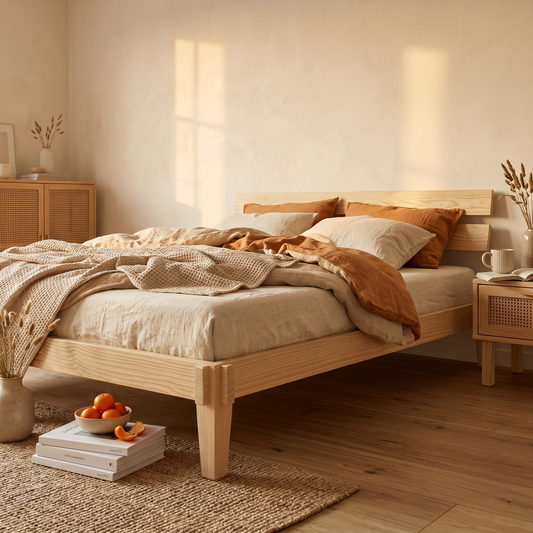
The Poka Bed by A Good Life is a solid pinewood bed with screwless joinery and a matte oil finish. It is priced in the range where the construction details justify the price: solid wood throughout, traditional joinery that gets tighter with use and a breathable finish that manages Indian humidity without stress.
The cost per year of use, calculated over fifteen years, makes it one of the most economical bedroom investments available. The quality per rupee, compared to a ₹20,000 bed replaced every four years, is not close. The ₹20,000 bed is cheaper on day one. The Poka Bed is cheaper over the life of the furniture. Choose the one that is cheaper over the life of the furniture.