
Every design language that endures does so because it is rooted in something true. Japanese design is rooted in the acceptance of impermanence and the beauty of the unfinished. Indian craft traditions are rooted in the intimacy of making — the relationship between the hand, the material and the object. When these two sensibilities meet, the result is not a hybrid. It is a conversation.
Indi-Japandi is that conversation, applied to the home. And nowhere does it find more natural expression than in the kitchen.
What Each Tradition Brings
Japanese design brings restraint. The discipline of removing what is unnecessary. The preference for natural materials in their honest state. The understanding that a well-proportioned empty space is as important as what fills it. Wabi-sabi — the acceptance of imperfection and the beauty of things that show their age — is not a style choice. It is a philosophy that changes how you see a room.
Indian craft tradition brings warmth. The knowledge that a handmade object carries the presence of the person who made it. The comfort of natural materials — wood, stone, cotton, clay — that have been used in Indian homes for centuries because they work. The understanding that a kitchen is not a utility room but a place of gathering, of daily ritual, of the particular intimacy that comes from feeding people you love.
Together, these traditions produce a kitchen that is quiet without being cold. Minimal without being austere. Warm without being cluttered.
The Palette
The Indi-Japandi kitchen palette is drawn from the natural world. Warm whites and soft off-whites that read differently in morning light and evening light. The honey tones of solid pinewood, deepening toward amber at the grain. Stone in grey or warm beige — not polished to a mirror finish but honed to a matte that shows the material's texture. Brass or blackened iron hardware, used sparingly.
This is not a palette assembled from trend forecasts. It is a palette that has existed in Indian and Japanese homes for centuries, because it is drawn from the materials that both cultures have always worked with. It does not date because it was never fashionable. It was always simply right.
The Materials
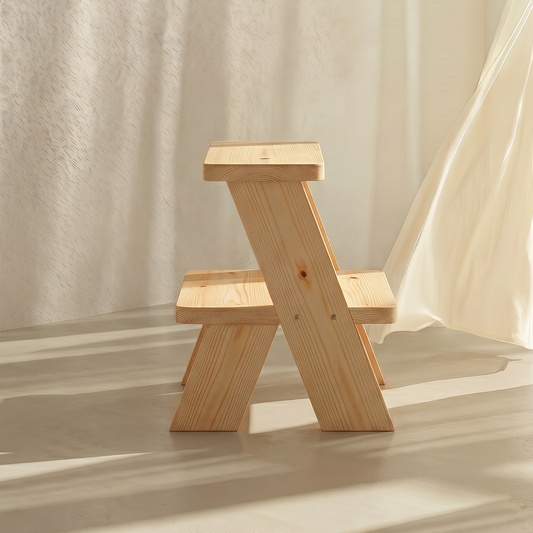
Solid pinewood is the natural primary material for an Indi-Japandi kitchen. Its pale, warm grain sits comfortably within both design traditions. It is a material that Indian craftsmen have worked with for generations. It carries the wabi-sabi quality of honest imperfection — the knots, the grain variation, the way it responds to light — that Japanese design values. And it ages in the direction of beauty rather than away from it.
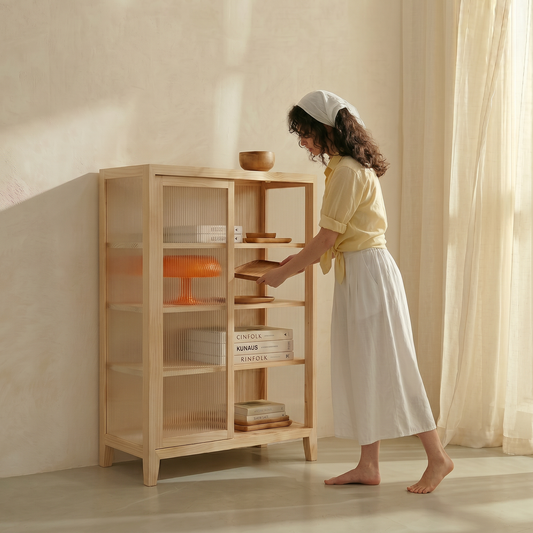
Stone countertops in a complementary tone ground the wood and add thermal mass. Open shelving, used with discipline, allows a few carefully chosen objects to be visible — a clay pot, a wooden board, a single plant — without creating visual noise.
The Details That Make the Difference
In an Indi-Japandi kitchen, the details are not decorative. They are structural. The way a cabinet door is hung so that it sits perfectly flush. The choice of a recessed handle over a protruding one. The decision to leave a wall bare rather than fill it with cabinetry. The single wooden shelf that gives the eye somewhere to rest in an otherwise neutral room.
These decisions require confidence. The confidence to leave things out. To trust that a well-made, well-proportioned kitchen does not need to announce itself. That the quality of the making will be felt before it is seen.
A Kitchen That Belongs
The Indi-Japandi kitchen does not feel imported. It does not feel like a Western design trend applied to an Indian home. It feels like it belongs — because it draws from traditions that are already present in the Indian domestic landscape, and combines them with a discipline and restraint that makes the result feel contemporary without feeling foreign.
A kitchen that belongs to its home, to its culture and to the people who use it every day. That is what Indi-Japandi makes possible. And in the kitchen, where belonging matters more than anywhere else, that is everything.